A treatise on chemistry. Vol. III, The chemistry of the hydrocarbons and their derivatives, or, Organic chemistry. Part I / by H.E. Roscoe & C. Schorlemmer.
- Henry Enfield Roscoe
- Date:
- 1881
Licence: Public Domain Mark
Credit: A treatise on chemistry. Vol. III, The chemistry of the hydrocarbons and their derivatives, or, Organic chemistry. Part I / by H.E. Roscoe & C. Schorlemmer. Source: Wellcome Collection.
Provider: This material has been provided by University of Bristol Library. The original may be consulted at University of Bristol Library.
98/744 (page 80)
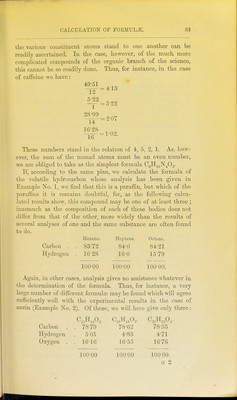
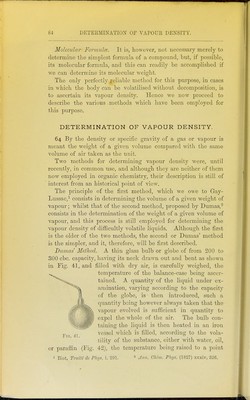
![DETERMINATION OF OXYGEN. 61 This element is very seldom determined directly, its amount being usually obtained after the percentage of all the other elements has been determined, for if these numbers do not add up to 100, the difference is usually taken to be the percent- age of oxygen. It is however in this case absolutely necessary that we should know positively what other elements are present, and that the amount of each of these should be determined as accurately as possible, for if one be overlooked, the results of the analysis will, of course, lead to totally incorrect formula;. A classical example of this kind of error is that of the analysis of taurine, a crystalline compound occurring in the animal kingdom. The formula CgHr^NOg was long adopted as expressing the composition of this substance, until Redtenbacher found that the body contained sulphur. The reason of the non- detection of the sulphur was, that both in constitution and in properties taurine differed from all the sulphur compounds then known. Moreover, the apparent truth of this formula could be upheld with some show of reason, inasmuch as the atomic weight of sulphur is double that of oxygen, and when the amount of the sulphur was ascertained, the formula of the substance was shown to be CgH^NOgS. A method for the direct determina- tion of oxygen is, therefore, much to be desired, not onlj'- for the purpose of avoiding errors of this kind, but also because such a determination would serve as a valuable control of the correctness of the analysis. Unfortunately, none of the various methods which have been as yet proposed for this purpose have come into general use, and the reader is referred to the original papers in which these proposals are described.^ CALCULATION OF ANALYSES. 62 Percentage Composition. Wlien a substance has been com- pletely analysed, its percentage composition is calculated. The following examples illustrate the nature of this simple ojieration. ^ Wanklyn and Frank, Phil. Mag. [4] xxvi. 554 ; Baumhauer, ZeitscJi. anal. Chcni. 1866, 114 ; Tiadcnburg, Ann. Ohcm. Pharm. cxxxv. 1 ; Mitscherlich, Pogrf. Ann. cx.xx. 536 ; Crcticr, Zcilsch. anal. Clicm. 1874, 1.](https://iiif.wellcomecollection.org/image/b2144903x_0098.jp2/full/800%2C/0/default.jpg)