The ferns of Great Britain and their allies, the club-mosses, pepperworts, and horsetails / by Anne Pratt ; published under the direction of the Committee of General Literature and Education, appointed by the Society for Promoting Christian Knowledge.
- Anne Pratt
- Date:
- [1871]
Licence: Public Domain Mark
Credit: The ferns of Great Britain and their allies, the club-mosses, pepperworts, and horsetails / by Anne Pratt ; published under the direction of the Committee of General Literature and Education, appointed by the Society for Promoting Christian Knowledge. Source: Wellcome Collection.
235/334
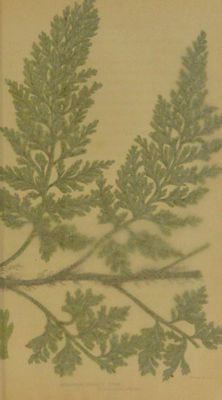
![terminated by a linear oblong cluster of fructification. Our only British species of this genus is easily known from all other native ferns by its fan-shaped leaflets, but the characteristics of the genus are to be found in the veining and the marginal fructification. The plant is called True Maiden-hair, to distinguish it from some other ferns w’hich share with it its familiar name. It is one of the loveliest of our native plants, and in its wild state is among the most rare; but it is familiarly known to fern-lovers, because it is one of the most frecpient ferns grown in closed glass cases, where it attains great perfection, and where it is often the oompaniQu of another species brought from ]\Iatleira, which, though having larger fronds, is not more elegant. The main stalk of our Maiden-hair is seldom thicker than a ])ackthread, and the little stidks which support the thin fan-shaped pinnules are so slight and elastic, so black and hair-like, as to have gained for the fern its spe- cific name. Its slender creeping rhizome is shaggy, with black hair-like scales, and the base of the stipes is of a rich red-brown colour. The fronds, which grow in lax tufts, make their appearance about May, and are matured by Jnnej they arc usually about six or seven, but sometimes twelve inches in height. They are either twice or thrice pinnate. The pinnae, or branches, diverge alternately from the stalks; the little leaf-like ])inmdes are also alternate, and each is placed on a separate stalk. The form of the leaflets, though varying much in dif- ferent situations, is yet more or less fan-shaped, the terminal one being often wedge-shaped. The margin is lobed, the barren lobes are serrated, but the edges of p](https://iiif.wellcomecollection.org/image/b28122306_0235.jp2/full/800%2C/0/default.jpg)