The ferns of Great Britain and their allies, the club-mosses, pepperworts, and horsetails / by Anne Pratt ; published under the direction of the Committee of General Literature and Education, appointed by the Society for Promoting Christian Knowledge.
- Anne Pratt
- Date:
- [1871]
Licence: Public Domain Mark
Credit: The ferns of Great Britain and their allies, the club-mosses, pepperworts, and horsetails / by Anne Pratt ; published under the direction of the Committee of General Literature and Education, appointed by the Society for Promoting Christian Knowledge. Source: Wellcome Collection.
269/334
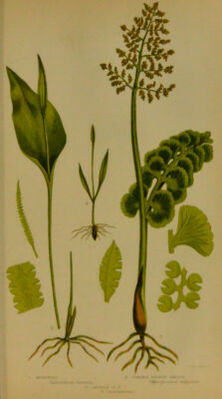
![one, while the whole is closely Avrapped in scale-like sheaths. The plant, when in .Tune it has become fully developed, is from three to eight, or more rarely ten inches in height, of a dull yellowish green colour, the lower part or stipes being succulent and hollow, and having at its base the remains of the scale-like sheath which once invested it. About half-way up it divides into two branches. The leafy branch is pinnate, and from three to eight pairs of crescent or fan-shaped leaflets are closely crowded upon it, their outer margin indented with slightly-rounded notches. The veins radiate towards the margin, one vein extending into each notch. The fertile branch of the fern is erect and branched, the branches being generally about the same in number as the pinnules on the leafly branch ; these side pinnae are again divided into lesser branches, on which the fructification grows. This forms a spike distinct from the leafy expansion, and is not, as in Osmunda, a contraction of the green ])art, nor are the clusters or capsules crowded, like those of that fern, into a mass; but though nearly touching each other, they are separate, and arranged in single rows along the branches of the spike. The capsules are globular in form, without stalks, smooth, composed of two concave valves, and are at first yellow and afterwards brown. The fern varies in different situations, and in one form the pinnae are pinnatifid ; but it is at all times so distinct from any other British fern that it is never difficult of recognition. It is known throughout Europe and Northern Asia. It is sometimes called Osmunda Lundria, or Lundria minor.](https://iiif.wellcomecollection.org/image/b28122306_0269.jp2/full/800%2C/0/default.jpg)