Physical diagnosis : a guide to methods of clinical investigation / by G.A. Gibson and William Russell.
- George Alexander Gibson
- Date:
- 1890
Licence: Public Domain Mark
Credit: Physical diagnosis : a guide to methods of clinical investigation / by G.A. Gibson and William Russell. Source: Wellcome Collection.
Provider: This material has been provided by The University of Leeds Library. The original may be consulted at The University of Leeds Library.
268/412 (page 246)
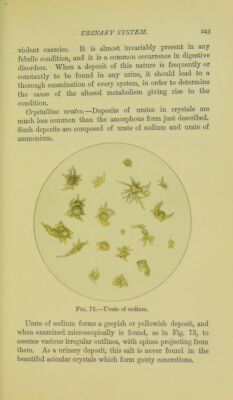
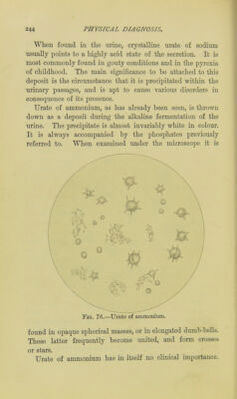
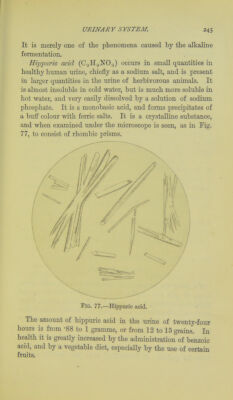
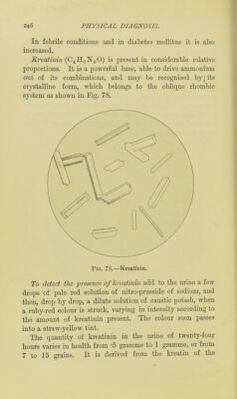
![In felDrile conditions and in diabetes mellitus it is also increased. Kreatinin (C4H7N3O) is present in considerable relative proportions. It is a powerful base, able to drive ammonium out of its combinations, and may be recognised by] its crystalline form, which belongs to the oblique rhombic system as shown in Fig. 78. Fig. 78.—Kreatinin. To detect the presence ofkreatinin add to the urine a few drops of pale red solution of nitro-prusside of sodium, and then, drop by drop, a dilute solution of caustic potash, when a ruby-red colour is struck, varying in intensity according to the amount of kreatinin present. The colour soon passes into a straw-yellow tint. The quantity of kreatinin in the urine of twenty-four hours varies in health from -5 gramme to 1 gramme, or from 7 to 15 grains. It is derived from the kreatin of the](https://iiif.wellcomecollection.org/image/b21503217_0268.jp2/full/800%2C/0/default.jpg)