Volume 1
A manual of pathological anatomy / By Carl Rokitansky.
- Rokitansky, Karl, Freiherr von, 1804-1878.
- Date:
- 1849-1854 [v. 1, 1854]
Licence: Public Domain Mark
Credit: A manual of pathological anatomy / By Carl Rokitansky. Source: Wellcome Collection.
24/474 page 4
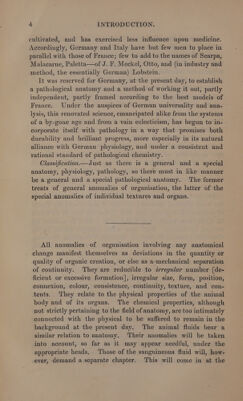
![cultivated, and has exercised less influence upon medicine. Accordingly, Germany and Italy have but few men to place in parallel with those of France; few to add to the names of Scarpa, Malacarne, Paletta—of J. F. Meckel, Otto, and (in industry and method, the essentially German) Lobstein. -It was reserved for Germany, at the present day, to establish a pathological anatomy and a method of working it out, partly independent, partly framed according to the best models of France. Under the auspices of German universality and ana- — lysis, this renovated science, emancipated alike from the systems of a by-gone age and from a vain eclecticism, has begun to in- - corporate itself with pathology in a way that promises both durability and brilliant progress, more especially in its natural alliance with German physiology, and under a consistent. and rational standard of pathological chemistry. Classification.—Just as there is a general and a ose anatomy, physiology, pathology, so there must in like manner be a general and a special pathological anatomy. The former treats of general anomalies of organisation, the latter of the special anomalies of individual textures and organs. All anomalies of organisation involving any anatomical change manifest themselves as deviations in the quantity or quality of organic creation, or else as a-mechanical separation of continuity. They are reducible to ¢trregular number [de- ficient or excessive formation], irregular size, form, position, connexion, colour, consistence, continuity, texture, and con- tents. They relate to the physical properties of the animal — body and of its organs. The chemical properties, although not strictly pertaining to the field of anatomy, are too intimately connected with the physical to be suffered to remain in the background at the present day. The animal fluids bear a similar relation to anatomy. ‘Their anomalies will be taken into account, so far as it may appear needful, under the appropriate heads. Those of the sanguineous fluid will, how- ever, demand a separate chapter. ‘This will come in at the](https://iiif.wellcomecollection.org/image/b33099078_0001_0024.jp2/full/800%2C/0/default.jpg)