The Attorney-General and others -v- The Mayor, aldermen & citizens of the city of Nottingham. Minutes of evidence (February 10 - February 15, 1904).
- Great Britain. High Court of Justice. Chancery Division.
- Date:
- [1904?]
Licence: In copyright
Credit: The Attorney-General and others -v- The Mayor, aldermen & citizens of the city of Nottingham. Minutes of evidence (February 10 - February 15, 1904). Source: Wellcome Collection.
Provider: This material has been provided by London School of Hygiene & Tropical Medicine Library & Archives Service. The original may be consulted at London School of Hygiene & Tropical Medicine Library & Archives Service.
259/284 (page 255)
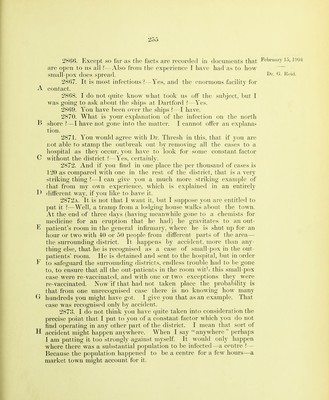
![2866. Except so far as the facts are recorded in documents that l^ebiuaiy 15, v.m are open to us all ?—Also from the experience I have had as to how small-pox does spread. I^'- '^'''l- 2867. It is most infectious ?—Yes, and the enormous facility for A contact. 2868. I do not quite know what took us oft' the subject, but T was going to ask about the ships at Dartford ?—Yes. 2869. You have been over the ships ?—I have. 2870. What is your explanation of the infection on the north 1^ shore ?—I have not gone into the matter. I cannot offer an explana- tion. 2871. You would agree with Di-. Thresh in this, that if you are not able to stamp the outbreak out by removing all the cases to a hospital as they occur, you have to look for some constant factor C without the district ?—Yes, certainly. 2872. And if you find in one place the per thousand of cases is 120 as compared with one in the rest of the district, that is a ver}'- striking thing ?—I can give you a much more striking example of that from my own experience, which is explained in an entirely different M^ay, if you like to have it. 2872a. It is not that I want it, but I suppose you are entitled to put it ?—Well, a tramp from a lodging house v^'alks about the town. At the end of three days (having meanwhile gone to a chemists for medicine for an eruption that he had) he gravitates to an out- E patient's room in the general infii-mary, where he is shut up for an hour or two with 40 or 50 people from different parts of the area— the surrounding district. It happens by accident, more than any- thing else, that he is recognised as a case of small-pox in the out- patients' room. He is detained and sent to the hospital, l)ut in order F to safeguard the surrounding districts, endless trouble had to be gone to, to ensure that all the out-patients in the room wit^ this small-pox case were re-vaccinated, and with one or two exceptions they Avere re-vaccinated. Now if that had not taken place the probability is that from one unrecognised case there is no knowing how many Gr hundreds you might have got. I give you that as an example. That case was recognised only by accident. 287;^ I do not think you have quite taken into consideration the precise point that I put to you of a constant factor which you do not ffnd operating in any other part of the district. I mean that sort of H accident might happen anywhere. When I say anywhere ])erhaps I am putting it too strongly against myself It would only happen where there was a substantial population to be infected—a centre ?— Because the population happened to be a centre for a few hours—a market town might account for it.](https://iiif.wellcomecollection.org/image/b21358606_0259.jp2/full/800%2C/0/default.jpg)