Licence: Public Domain Mark
Credit: Prevention and restriction of small-pox. Source: Wellcome Collection.
Provider: This material has been provided by the Augustus C. Long Health Sciences Library at Columbia University and Columbia University Libraries/Information Services, through the Medical Heritage Library. The original may be consulted at the the Augustus C. Long Health Sciences Library at Columbia University and Columbia University.
5/24
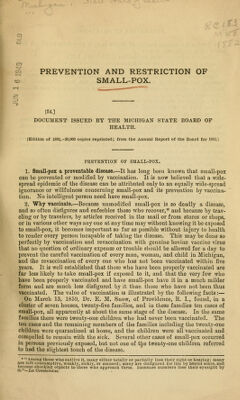
![CD CO S PREVENTION AND RESTRICTION OF ^ SMALL-POX. [54.] DOCUMENT ISSUED BY THE MICHIGAN STATE BOARD OF HEALTH. (Edition of 1832,-30,000 copies reprinted; from the Annual Report of the Board for 1331.) PREVENTION OF SMALL-POX. 1. Small-pox a preventable disease.—It has long been known that small-pox can be prevented or modified by vaccination. It is now believed that a wide- spread epidemic of the disease can be attributed only to an equally wide-spread ignorance or willfulness concerning small-pox and its prevention by vaccina- tion. No intelligent person need have small-pox. 2. Why vaccinate.—Because unmodified small-pox is so deadly a disease, and so often disfigures and enfeebles those who recover,* and because by trav- eling or by travelers, by articles received in the mail or from stores or shops, or in various other ways any one at any time may without knowing it be exposed to small-pox, it becomes important so far as possible without injury to health to render every person incapable of taking the disease. This may be done so perfectly by vaccination and revaccinatioii with genuine bovine vaccine virus that no question of ordinary expense or trouble should be allowed for a day to prevent the careful vaccination of every man, woman, and child in Michigan, and the revaccination of every one Avho has not been vaccinated within five years. It is well established that those who have been properly vaccinated are far less likely to take small-pox if exposed to it, and that the very few who have been properly vaccinated and have small-pox have it in a much milder form and are much less disfigured by it than those who have not been thus vaccinated. The value of vaccination is illustrated by the following facts:— On March 13, 1859, Dr. E. M. Snow, of Providence, R. I., found, in a cluster of seven houses, twenty-five families, and in these families ten cases of small-pox, all apparently at about the same stage of the disease. In the same families there were twenty-one children who had never been vaccinated. The ten cases and the remaining members of the families including the twenty-one children were quarantined at home, and the children were all vaccinated and compelled to remain with the sick. Several other cases of small-pox occurred in persons previously exposed, but not one of t^e twenty-one children referred to had the slightest touch of the disease. * Among those -who outlive it, many either totally or ptirtially lose their sight or hearing; many are left consumptive, weakly, sickly, or maimed; many are disligured for life by horrid scars, and become shocking objects to those who approach them, immense numbers lose their eyesight by it.'—ia ConUa7ni)ic.](https://iiif.wellcomecollection.org/image/b21230444_0005.jp2/full/800%2C/0/default.jpg)