Licence: Public Domain Mark
Credit: Lizars against Syme. Source: Wellcome Collection.
Provider: This material has been provided by the Royal College of Physicians of Edinburgh. The original may be consulted at the Royal College of Physicians of Edinburgh.
2/3 page 2
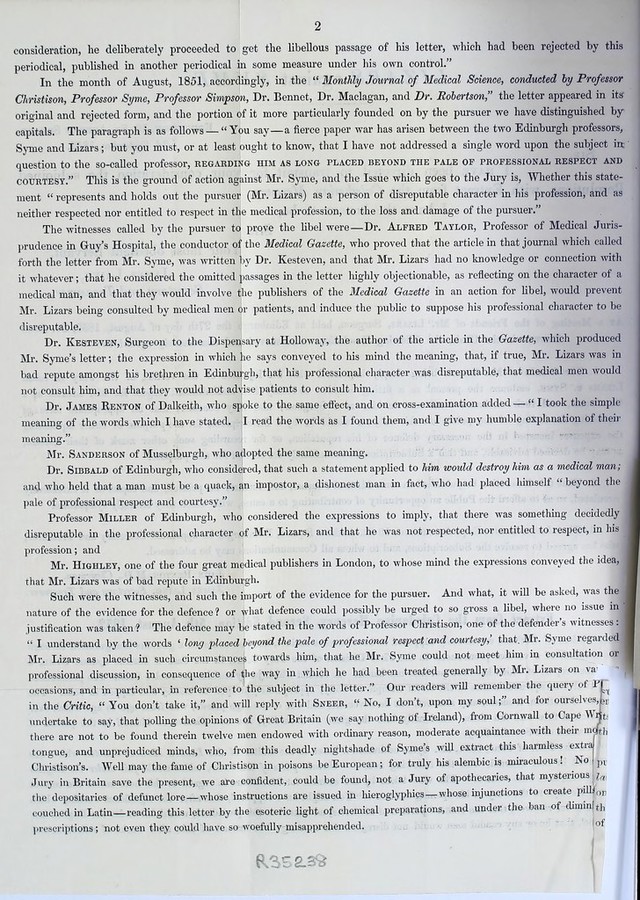
![2 consideration, he deliberately proceeded to get the libellous passage of his letter, which had been rejected by this periodical, published in another periodical in some measure under liis own control.” In the month of August, 1851, accordingly, in the “ Monthly Journal of Medical Science, conducted by Professor Christison, Professor Syme, Professor Simpson, Dr. Bonnet, Dr. Maclagan, and Dr. Pobertson, the letter appeared in its' original and rejected form, and the portion of it more particularly founded on by the pursuer we have distinguished by capitals. The paragraph is as follows — “You say—a fierce paper war has arisen between the two Edinburgh professors, Syme and Lizars; but you must, or at least ought to know, that I have not addressed a single word upon the subject in question to the so-called professor, regarding him as long placed beyond the pale of professional respect and courtesy.” This is the ground of action against Mr. Syme, and the Issue which goes to the Jury is, Whether this state- ment “ represents and holds out the pursuer (Mr. Lizars) as a person of disreputable character in his profession, and as neither respected nor entitled to respect in the medical profession, to the loss and damage of the pursuer.” The witnesses called by the pursuer to prove the libel were—Dr. Alfred Taylor, Professor of Medical Juris- prudence in Guy’s Hospital, the conductor of the Medical Gazette, who proved that the article in that journal which called forth the letter from Mr. Syme, was written by Dr. Kesteven, and that Mr. Lizars had no knowledge or connection with it whatever; that he considered the omitted passages in the letter highly objectionable, as reflecting on the character of a medical man, and that they would involve the publishers of the Medical Gazette in an action for libel, would prevent Mr. Lizars being consulted by medical men or patients, and induce the public to suppose his professional character to be disreputable. Dr. Kesteven, Surgeon to the Dispensary at Holloway, the author of the article in the Gazette, which produced Mr. Syme’s letter; the expression in which lie says conveyed to his mind the meaning, that, if true, Mr. Lizars was in bad repute amongst his brethren in Edinburgh, that his professional character was disreputable, that medical men would not consult him, and that they would not advise patients to consult him. Dr. James Benton of Dalkeith, who spoke to the same effect, and on cross-examination added — “I took the simple meaning of the words which I have stated. I read the words as I found them, and I give my humble explanation of their meaning.” Mr. Sanderson of Musselburgh, who adopted the same meaning. Dr. Sibbald of Edinburgh, who considered, that such a statement applied to him would destroy him as a medical man; and who held that a man must be a quack, an impostor, a dishonest man in fact, who had placed himself “ beyond the pale of professional respect and courtesy.” Professor Miller of Edinburgh, who considered the expressions to imply, that there was something decidedly disreputable in the professional character of Mr. Lizars, and that he was not respected, nor entitled to respect, in his profession; and Mr. Highley, one of the four great medical publishers in London, to whose mind the expressions conveyed the idea, that Mr. Lizars was of bad repute in Edinburgh. I Such were the witnesses, and such the import of the evidence for the pursuer. And what, it will be asked, as the nature of the evidence for the defence ? or what defence could possibly be urged to so gross a libel, whei e no issue in justification was taken? The defence may be stated in the words of Professor Christison, one of the defendei s witnesses. “ I understand by the words ‘ long placed beyond the pale of professional respect and courtesy,’ that. Mr. Syme regarded Mr. Lizars as placed in such circumstances towards him, that he Mr. Syme could not meet him m consultation or professional discussion, in consequence of t)lie way in which he had been treated generally by Mr. Lizars on va occasions, and in particular, in reference to the subject in the letter. Our readers will remember the quei v of in the Critic, “ You don’t take it,” and will reply with Sneer, “ No, I don’t, upon my soul;” and for ourselvesd,,; undertake to say, that polling the opinions of Great Britain (we say nothing of Ireland), from Cornwall to Cape Wxjts there are not to be found therein twelve men endowed with ordinary reason, moderate acquaintance with their mqfth tongue, and unprejudiced minds, who, from this deadly nightshade of Symes will extract this harmless extia Christison’s. Well may the fame of Christison in poisons be European; for truly his alembic is miraculous ! No ]H Jury in Britain save the present, we are confident, could be found, not a Jury of apothecaries, that mystei ious ia, the depositaries of defunct lore—whose instructions are issued in hieroglyphics-^whose injunctions to create pills0n couched in Latin—reading this letter by the esoteric light of chemical preparations, and undei the ban of dimin th prescriptions; not even they could have so woefully misapprehended. I of &SS2-3%](https://iiif.wellcomecollection.org/image/b2193051x_0005.jp2/full/800%2C/0/default.jpg)


 No text description is available for this image
 No text description is available for this image
 No text description is available for this image