Antiquæ linguæ Britannicæ thesaurus. A Welsh and English dictionary, wherein the Welsh words are often exemplified by select quotations from celebrated ancient authors; and many of them etymologized, and compared with the Oriental and other languages ... adorned with many valuable British antiquities, to elucidate the meaning of obscure words. To which are annexed, a Welsh and English botanology, and a large collection of Welsh proverbs. And to the whole is prefixed, a compendious Welsh grammar, with the rules in English; also, to which are added, The rules of Welsh poetry / By the late Rev. Thomas Richards, Coychurch.
- Thomas Richards of Coychurch
- Date:
- 1839
Licence: Public Domain Mark
Credit: Antiquæ linguæ Britannicæ thesaurus. A Welsh and English dictionary, wherein the Welsh words are often exemplified by select quotations from celebrated ancient authors; and many of them etymologized, and compared with the Oriental and other languages ... adorned with many valuable British antiquities, to elucidate the meaning of obscure words. To which are annexed, a Welsh and English botanology, and a large collection of Welsh proverbs. And to the whole is prefixed, a compendious Welsh grammar, with the rules in English; also, to which are added, The rules of Welsh poetry / By the late Rev. Thomas Richards, Coychurch. Source: Wellcome Collection.
24/616 page 12
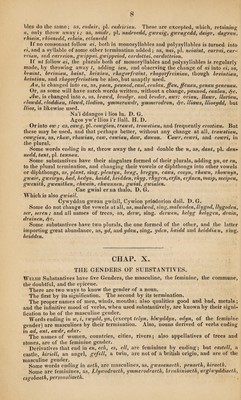
![reg'ularîy by adding tlie syllable acli ío tlie i)ositive ; as, duachy blacker; nach^ ŵliiter. \Ve call tlie superlative, Chiüanegol yn y radd uchaf^ in tbe bighest degree, or, Uchel-radcL tbe bigbest degree ; and it is înade by adding tbe syllable af io the positive ; as, duaf, blackest; gwynnaf, wbitest. All words double tbe fiiial corisonants of tbe positives, in tbe comparative aud superlative deg'rees ; except, V Sucb as circunif]ex tbe vowel of tbeir positives, witîi their Gompounds; as, glân, glanach, glanaf,aflan, aflanach, afanaf, cas, casach, cas~ af, atgaSy atgasach, atgasaf; 2 Sucb positives as already end W'itli two consonanfs, wbefber sirailar or dissirailar ; as, byrr, hyrrach, byrraf; pell, pellach, pellaf; hagr, hagrach, hagraf. Positives ending in b, d, g, in tbe comparative and superlative, cbange b ìnto pp ; d ìnto tt; and g into cc; as, cyffelyb, cyff'elyppach, cyffelyppaf,caled,calettach, calettaf, tebyg, tebyccach, tehyccaf. PositÌYes baving ai, cbange ai into ei, in tbe coraparative and superlative ; as, rhaid,rheitiach, rheitiaf. Positives havìng aiü, cbange «îí) into o in the coraparative and superlative; as, tlaicd, tlottach, tlottaf. Positives baving w for their vowel, change w into y in tbe coraparative and super- lative ; as, hrwnt, bryntach, bryntaf; tritiìn, trymmach, trymmaf, THESE FOLLOWING ARE ANOMALOUS OR IRREGULAR COMPARISONS. ' good ; better ; ^orím, best. Drwg^ bad ; gwacth, worse, gioaethaf, w'orst, Tbis w'ord, and tbe nine foîlowing, form the superlative from tbe comparativ6, not from tbe positive. Bach, or bychan, little; llai, less, lleiaf, leasí. Maior, greát, nuoy, greater, nnoyaf, greatest. Hir, long, hwy, longer, hwyaf, longest. Hen, old, hŷn, elder, /iywa/; eldest. Isel, low, îs, lower, isaf, lowest. Uchel, bigli, uwch, and uch, bigher, uchaf bigbest. Agos, near, nês, nearer, nesaf nearest. Hawdd, easy, haios, raore easy, hawsaf, most easy. Lìydan, broad, llèd, broader, llettaf, broadesí. LÎawer many, borrows mwy, more, and mwyaf, raosí, frorn maior. Buan, or cloi, S. W. swìft, huanach, and cynt, swdfter; buanaf and cyntaf s wifs t leuangc, young, iau, and ieuangach, younger; ieuaf and ieuangaf, youngest, and sometiraes, ifaý. ^//flW,out, eíí/ra/, utmost or outermosb Diwedd, a substantive signifying end, rnabes tbe superlative diweddaf last, and also c/ŵeíÄfl/. 1 1 1 . Trech stronger, is a coraparative wanting a positive, and makes its superlative trechaf. But Siòn Tudur bath trechach. Blnenaf, foremost, is a superlative from hlaen. Olaf last, is a superlative frora ÔU Tbe Welsb Language, besides tbe tbree degrees of comparison already mentioned, batb a sort of comparison, wbicb iraports sometimes equality; sometimes admi- ration • and may be explained in Englisb by aŵ, so, how ; as, cyn laned ac yntef, as fair as be. Glaned yto, bow fair be ìs; melused yw, bow sweet it is. It is formed of tbe positive by adding tbe syllable ed, according to tbe rules of forming tbe coraparative and superldtive degrees ; as, Hardd, barddacb, barddaf,bardded. Rbâd, rbattacb, rbattaf, rbatted, &c. In coustruction it batb prefixed to it, cyn ; as, cyn dehycced, as like ; er, altbough, ertecced y c/?/'fl;ec/i, thougli you speak never so fair. /í/cflg', prep. for ; rhag glaned nw'r calonnau. Gan, wbereas; gan hured yw. O, as, O fwyned ocdd. Och, och oeredyw chwiorydd. A, ac; O Dduw teg, a’icldaed dyn. It comes after tbe verb, baving its radical initial cbanged into its soft; as, edrych decced yio. Niwyddwn ddacd oedd. Mi a welaf reitied ydyw. And after pronouns, Gwae fi o'^i gweddi, gw'ae fi ei gwcddwed. D. N,](https://iiif.wellcomecollection.org/image/b29337392_0024.jp2/full/800%2C/0/default.jpg)