Antiquæ linguæ Britannicæ thesaurus. A Welsh and English dictionary, wherein the Welsh words are often exemplified by select quotations from celebrated ancient authors; and many of them etymologized, and compared with the Oriental and other languages ... adorned with many valuable British antiquities, to elucidate the meaning of obscure words. To which are annexed, a Welsh and English botanology, and a large collection of Welsh proverbs. And to the whole is prefixed, a compendious Welsh grammar, with the rules in English; also, to which are added, The rules of Welsh poetry / By the late Rev. Thomas Richards, Coychurch.
- Thomas Richards of Coychurch
- Date:
- 1839
Licence: Public Domain Mark
Credit: Antiquæ linguæ Britannicæ thesaurus. A Welsh and English dictionary, wherein the Welsh words are often exemplified by select quotations from celebrated ancient authors; and many of them etymologized, and compared with the Oriental and other languages ... adorned with many valuable British antiquities, to elucidate the meaning of obscure words. To which are annexed, a Welsh and English botanology, and a large collection of Welsh proverbs. And to the whole is prefixed, a compendious Welsh grammar, with the rules in English; also, to which are added, The rules of Welsh poetry / By the late Rev. Thomas Richards, Coychurch. Source: Wellcome Collection.
28/616 page 16
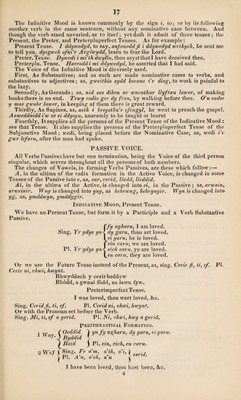
![caäiv, ceidWi galw, geiliO. And if they ]iave aalso in their peiiult. tlmí a is moreover clmng'ed inío e, as, ç,tvuliardd, gweheirdd ; '^warc/iadta, gwe'rchcidw, Wìien verhs ]iave a in the penultima, ande in the ultima, the a is ciianged inío e, and the| e into y; as, gtüared, gicergd, atteh, eftì/ò. Sonie verbs, wliich have o for tlie last vov\el for their radixes, change that q into ; as, tro, try, ton\ iyrr, rhodd, rhydd, ffo, ffy, golch, ^ylc1i,^dod, dyd, clo, cly, llosg, llysg; aud their compounds, ymdry, ymylch, datcly, dyry, ymdry. So, dioích, diylch, esgor, esgyr, gwrthod, gwrthyd, cymmorth, cymmyrth. Others change o into aw; as, toddi, taicdd, boddi, bawdd, ioli, tawl, moii, mawl. îf verbs, having o in the uitima, have a or o ìn the penultima, they change the á or 0 inío e, and the o of the uitirna inío y, as, gwrando, gwrendtj, gaào, gedy, taro, tery, addo, eddy, gosod, gesyd, aros, erys. Some verhs are reducible to no ruîes, as, of codi, diüg,oí dtoyn, chwardd, of cJnoerthin. A great corruption hath long since prevailed, hoth in talhing and writing Welsii, to make this person end inf^; as, sefiff, for saif, torriff, for tyrr, lieddtff, for lladd', but no verb ends thus, except the verb irregular catff, from caffael. Jiyn wyf a â dan ei wâd, Er nad â ’r un a’i dywad. H. K. Llywelyn drows-dynn a ä drosti, D. G. Ac a ä dan Gaeo dir. L. G. Si^ Imperätive Mood. nnguìar. Plural. 1 rCarion, let us love. Ciir, love thou. 1 ^ , leniim love. ^ leTtliem love. Tliè second person singular is the sarae witii tlie third person singular of the future tcnse of the indicatiye, èxcept in such verbs as ciiange the vowels of the fuíure, as, tyrr, try, gyich, &c. which make here no change, as, torr, tro, golch, &c. And froni gado is forrned gâd. The third person singuìar ends sometimes in id, with tlie usual change of the Yowels, as, cerid Duio fi, for cared. All the plural is always the sarne as the plural of the future tense of the indica- tive mood, save only that the poeís sometiraes make the third persou eiid in ent, as carent, for carant. And in ont, from the future of the poíential, whence t being thrown away, on ; as, Cornwal Caerlleon gaìwon ara geiiiog. li. N. Optatîye Mood. Tlie Optative, Potential and Suhjunctive Moods are the same iii voice; and tbeir slgnificaíion is distinguished only by the particles joiaed to them. They want the Present Tense. Preterimperfect Tense. Sing. Carwn, Cerît, Carai. Pl. Carem, Carech, Careni. The third person piural, in the poets, ends alsoin aint, which Dr. Davies takes to he the genuine and reguîar termination of this person, from tlie third person siim gular, ai, \D. G. Nestwiw goeth, wenddoeth, wyn-ddaint aclfor, A mwy na rhagor i’m anrhegaint. And t being thrown away, ain. Ac na bain ar druain draed, for baint. D. G. But thewliole plural is made raostusually iii the poets, by changing the vowels of tlie penultiraa, aiid forming the termination by y ; as, Cerym, Cerych, Cerynt. Preterperfect and Preterpluperfect Tenses. Singular caraswn, carasit, carasai. Plural carasom, carasech, carasent. The plural, in this tense aìso, is often in the poets, caresym, caresych, caresynt. Future Tense. Singular Carwyf, cerych, caro. Plural Carom, caroch, caront. Infinitiye Mood. Tlie iníiiiitive mood hath various endings, ànd very frequently a consonant, buf is more commoniy ends with the.yow/elS; 'h o, ii. And soine end in au, an, ain.](https://iiif.wellcomecollection.org/image/b29337392_0028.jp2/full/800%2C/0/default.jpg)