Hand-book of physiology / by W. Morrant Baker and Vincent Dormer Harris.
- William Morrant Baker
- Date:
- 1888
Licence: Public Domain Mark
Credit: Hand-book of physiology / by W. Morrant Baker and Vincent Dormer Harris. Source: Wellcome Collection.
873/910 (page 847)
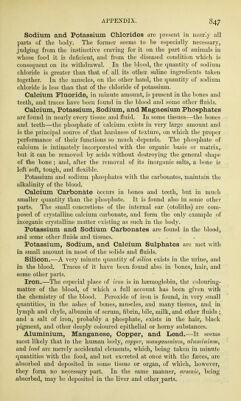
![Sodium and Potassium Chlorides are present in nearly all parts of the body. The former seems to be especially necessary, judging from the instinctive craving for it on the part of animals in whose food it is deficient, and from the diseased condition which is consequent on its withdrawal. In the l)lood, the quantity of sodium chloride is greater than thai of. all its otlier saline ingredients taken together. In the muscles, on the other hand, the quantity of sodium chloride is less than that of the chloride of potassium. Calcium Fluoride, in minute amount, is present in the bones and teeth, and traces have been found in the blood and some other fluids. Calcium, Potassium, Sodium, and Magnesium Phosphates ar6 found in nearly every tissue and fluid. In some tissues,—^the bones and teeth—the phosphate of calcium exists in very large amount and is the principal source of that hardness of texture, on which the proper performance of their functions so much depends. The phosphate of calcium is intimately incorporated with the organic basis or matrix,. but it can be removed by acids without destroying the general shape of the bone ; and, after the removal of its inorganic salts, a bone is left soft, tough, anil flexible. Potassium and sodium phosphates with the carbonates, maintaiii the alkalinity of the blood. Calcium 'Carbonate occurs in bones and teeth, but in much smaller quantity than the phosphate. It is found also in sonie other parts. The small concretions of the internal ear (otoliths) are com- posed of crystalline calcium carbonate, and form the only example of inorganic crystalline matter existing as such in the body. Potassium and Sodium Carbonates are found in the blood, and some other fluids and tissues. . . > ^ Potassium, Sodium, and Calcium Sulphates are met with in small amount in most of the solids and fluids. Silicon.—A very minute quantity of silica exists in the urine, and in the blood. Traces of it have been found also; in bones, hair, and some other jDarts. ... Iron.—The especial place of iron is in haemoglobin, the colouring- matter of the blood, of which a full account has been given with the chemistry of the blood. Peroxide of iron is found, in very small quantities, in the ashes of bones, muscles, and many tissues, and in lymph and chyle, albumin of serum, fibrin, ])ile, milk, and other fluids ;, and a salt of iron, probably a phosphate, exists in the hair, black, pigment, and other deeply coloured epithelial or horny substances. Aluminium, Manganese, Copper, and Lead.—It seems most likely that in the human body, copiJer, mangmiesium, aluminium^ and lead are merely accidental elements, which, being taken in minute quantities 'with the food, and not excreted at oiice with the faeces, are absorbed and deposited in some tissue or organ, of which, however, they form no necessary part. In the same manner, arsenic, being absorbed, may be deposited in the liver and oth^r parts. . . .](https://iiif.wellcomecollection.org/image/b20419016_0875.jp2/full/800%2C/0/default.jpg)