Popular treatises on science written during the Middle Ages, in Anglo-Saxon, Anglo-Norman, and English / Edited from the original manuscripts by Thomas Wright.
- Thomas Wright
- Date:
- 1841
Licence: Public Domain Mark
Credit: Popular treatises on science written during the Middle Ages, in Anglo-Saxon, Anglo-Norman, and English / Edited from the original manuscripts by Thomas Wright. Source: Wellcome Collection.
25/164 page 5
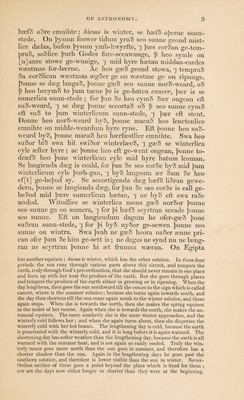
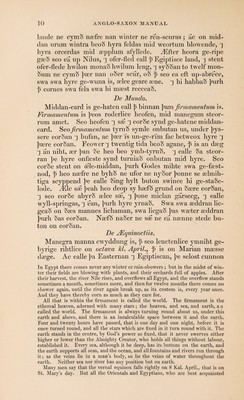
![decima Kalendas Aprilis. Embe Jns we sprecab eft swibor swa swa \ve ser be-heton. Be Nocte. Niht is ge-sett manrium to reste on ]?ysum middan-earde. Soblice on pam heofenlicnm ebele nis nan niht ge-htefd, ac J?aer is singal leoht buton aelcum ];ystrum. Ure eorSlice nyht soblice cymb ]mrh baere eorban sceade, J?onne seo sunne gseS on aefnunge under J?yssere eorban, Jtonne byb brere eorban bradnys betweox us ^ Jtaere sunnan p we hyre leoman lyht- inge nabbab, oS baet heo eft on ojterne ende up astihS. Wi- todlice }>eah Ipe hit wunderlic Jdnge, nis \>eos woruldlice niht nan Jung buton ];aere eorban sceadu, bettveox J?asre sunnan ^ mannkynne. Woruldlice ubwitan saedan, p seo sceadu astihS up ob baet heo becymb to J?aere lyfte ufe-weardan, J>onne be-yrnb se mona hwil-tidum Jtonne he full byb on baere sceade ufe-weardre, j faggeteb obbe mid ealle asweartab, for ]?am J?e he naefb Jtaere sunnan leoht J?a hwile Ipe he Jtaere sceade ord ofer yrnb ob baet ]?aere sunnan leoman hine eft on-lihton. Se mona naefb nan leoht buton of baere sunnan leoman, 3 he is ealra tungla nybemest, 3 for J?i be-yrnb on J?aere eorban sceade J^onne he full byb, na symle swa J^eah for ]?am bradan circule )?e is zocliacus ge-haten; under ]?am circule yrnb seo sunne -j se mona j twelf tunglena tacna. Witodlice baes monan trendel is symle ge-hal j ansund, J^eah be eall endemes eall- unga ne seine. Haeghwamlice baes monan lebht byb weax- ende obbe waniende feower prican Jmrh )?aere sunnan leoman; and he gaeb daeghwamlice obbe to J^aere sunnan obbe fram baere sunnan swa fela pricon, na p he becume to ]?aere sun¬ nan, for bam J?e seo sunne is micle ufor ]?onne se mona sy. He cymb swa J?eah ge-anunga foron }?a sunnan, ]?onne he of on the 12 Kal. Apr. About this we shall speak again more particularly as we have before promised. Night is ordained for men’s repose in this world. Truly in the heavenly coun¬ try there is no night, but there is continual light without any darkness. Our earthly night truly comes by the earth’s shadow, when the sun goes in the evening under this earth, then is the earth’s breadth between us and the sun, so that we have not the illumination of her ray until she again rises up at the other end. Cer¬ tainly, though it seem a wonderful thing, this worldlynight is nothing but the earth’s shadow between the sun and mankind. Worldly philosophers said that the sha¬ dow rises up till it come upwards to the atmosphere, and then the moon enters at times when he is full into the upward shadow, and changes or becomes altoge¬ ther darkened, because he has not the sun’s light while he runs over the edge of the shadow until the sun’s rays again illuminate him. The moon has no light ex¬ cept from the sun’s rays, and he is the lowest of all the planets, and therefore he enters the earth’s shadow when he is full, yet not always on account of the broad circle which is called Zodiac, under which circle run the sun and moon and twelve celestial signs. Truly the moon’s orb is always whole and perfect, although it does not shine always quite equally. Every day the moon’s light is waxing or waning four points through the sun’s light, and he goes daily either to the sun or from the sun so many points, not that he arrives at the sun, because the sun is much more elevated than the moon. Yet he comes before the sun, when](https://iiif.wellcomecollection.org/image/b29292244_0025.jp2/full/800%2C/0/default.jpg)
 No text description is available for this image
 No text description is available for this image
 No text description is available for this image