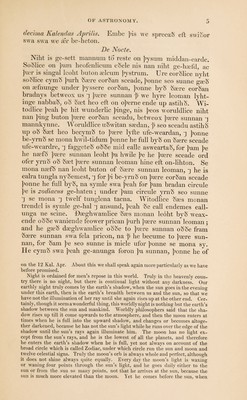
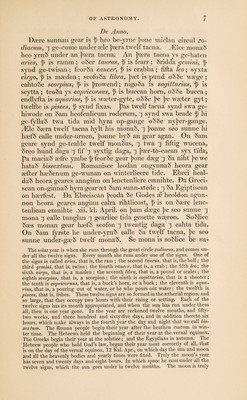
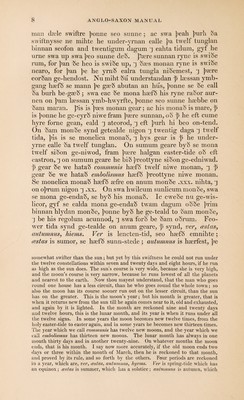
Popular treatises on science written during the Middle Ages, in Anglo-Saxon, Anglo-Norman, and English / Edited from the original manuscripts by Thomas Wright.
- Thomas Wright
- Date:
- 1841
Licence: Public Domain Mark
Credit: Popular treatises on science written during the Middle Ages, in Anglo-Saxon, Anglo-Norman, and English / Edited from the original manuscripts by Thomas Wright. Source: Wellcome Collection.
26/164 (page 6)
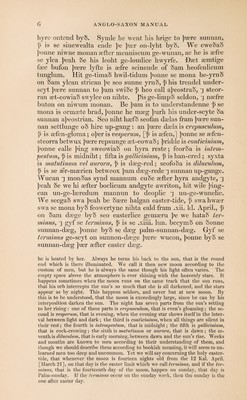
![hyre ontend byh. Symle he went his hrigc to paere sunnan, 'p is se sinewealta ende pe paer on-lyht byh. We cwehah ponne niwne monan aefter menniscum ge-wunan, ac he is aefre se ylca peah he his leoht ge-lomlice hwyrfe. f)aet aemtige faec bufon paere lyfte is aefre scinende of 'ham heofenlicum tunglum. Hit ge-timah hwil-tidum ponne se mona be-yrnh on ham ylcan strican pe seo sunne yrnh, f his trendel under- scyt paere sunnan to fam swihe f heo eall apeostrah, j steor- ran aet-eowiah swylce on nihte. pis ge-limph seldori, j naefre buton on niwum monan. Be pam is to understandenne f se mona is ormaete brad, ponne he maeg purh his under-scyte ha sunnan apeostrian. Seo niht haefh seofan daelas fram paere sun- nan settlunge oh hire up-gang : an paere daela is crepuscutum, f is aefen-gloma; oper is vesperum, [f is aefen,] ponne se aefen- steorra betwux paere repsunge aet-eowah; pridde is conticinium, ponne ealle ping sweowiah on hyra reste; feorha is intem- pestum, p is midniht; fifta is gallicinium, p is han-cred; syxta is matutinum vel aurora, p is daeg-red; seofoha is diluculum, p is se aer-maerien betweox pam daeg-rede J sunnan up-gange. Wucan y monhas synd mannum cube aefter hyra andgyte, *3 peah he we hi aefter boclicum andgyte awriton, hit wile ping- can un-ge-laeredum man nun to deoplic j un-ge-wunelic. We secgah swa peah be haere halgan easter-tide, f swa hwaer svva se mona byh feowertyne nihta eald fram .xii. kl. April., f on ham daege byh seo easterlice gemaeru pe we hatah ter¬ minus, j gyf se terminus, f is se .xiiii. lun. becymh on honne sunnan-daeg, ponne byh se daeg palm-sunnan-daeg. Gyf se terminus ge-scyt on sunnon-daege paere wucon, ponne byh se sunnan-daeg paer aefter caster daeg. he is heated by her. Always he turns his back to the sun, that is the round end which is there illuminated. We call it then new moon according to the custom of men, but he is always the same though his light often varies. The empty space above the atmosphere is ever shining with the heavenly stars. It happens sometimes when the moon runs on the same track that the sun runs, that his orb intercepts the sun’s so much that she is all darkened, and the stars appear as by night. This happens seldom, and never but at new moon. By this is to be understood, that the moon is exceedingly large, since he can by his interposition darken the sun. The night has seven parts from the sun’s setting to her rising: one of these parts is crepusculum, that is even’s gloaming; the se¬ cond is vesperum, that is evening, when the evening star shows itself in the inter¬ val between light and dark; the third is conticinium, when all things are silent in their rest; the fourth is intempestum, that is midnight; the fifth is gallicinium, that is cock-crowing; the sixth is matutinum or aurora, that is dawn ; the se¬ venth is diluculum, that is early morning, between dawn and the sun’s rise. Weeks and months are known to men according to their understanding of them, and though we should describe them according to bookish meaning, it will seem to un¬ learned men too deep and uncommon. Yet we will say concerning the holy easter- tide, that whenever the moon is fourteen nights old from the 12 Kal. April. [March 21], on that day is the easter limit which we call terminus, and if the ter¬ minus, that is the fourteenth day of the moon, happen on Sunday, that day is Palm-sunday. If the terminus occur on the Sunday week, then the Sunday is the one after easter day.](https://iiif.wellcomecollection.org/image/b29292244_0026.jp2/full/800%2C/0/default.jpg)