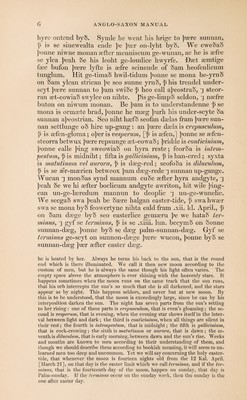
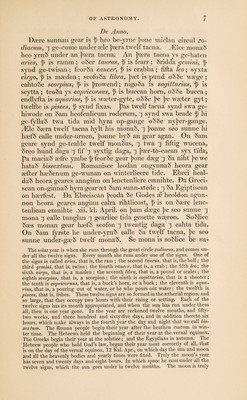
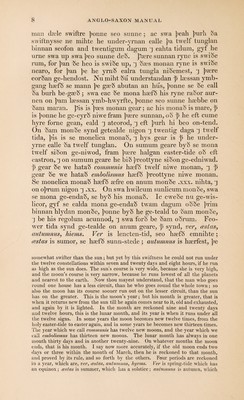
Popular treatises on science written during the Middle Ages, in Anglo-Saxon, Anglo-Norman, and English / Edited from the original manuscripts by Thomas Wright.
- Thomas Wright
- Date:
- 1841
Licence: Public Domain Mark
Credit: Popular treatises on science written during the Middle Ages, in Anglo-Saxon, Anglo-Norman, and English / Edited from the original manuscripts by Thomas Wright. Source: Wellcome Collection.
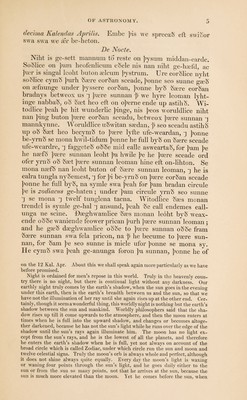
29/164 (page 9)
![href<5 obre emnihte; hiems is winter, se href<5 o]?erne sunn- stede. On ]?ysum feower tidum yrnS seo sunne geond mist- lice daelas, bufon )?ysum ymb-hwyrfte, j ]?aes eorban ge-tem- prab, soblice Jmrh Godes fore-sceawunge, f heo symle on [n] anre stowe ge-wunige, y mid hyre haetan middan-eardes waestmas for-baerne. Ac heo gaeb geond stowa, j temprab ha eorblican waestmas aegber ge on wTaestme ge on ripunge. ponne se daeg langab, f>onne gaeb seo sunne norb-weard, ob f heo becymb to fam tacne )te is ge-haten cancer, ]?aer is se sumerlica sunn-stede ; for ]?an be heo cymb baer ongean eft sub-weard, ^ se daeg )?onne sceortab ob f seo sunne cymb eft sub to fam winterlicum sunn-stede, j ]>aer eft stent. Donne heo norb-weard byb, ]?onne macab heo lenctenlice emnihte on midde-weardum hyre ryne. Eft J?onne heo sub- weard byb, Jtonne macab heo haerfaestlice emnihte. Swa heo subor bib swa hit swibor winterlaecb, j gaeb se winterlica cyle aefter hyre ; ac ]?onne heo eft ge-went ongean, Jtonne to- draefb heo ]?one winterlican cyle mid hyre hatum leoman. Se langienda daeg is ceald, for ]?an be seo eorbe byb mid J?am winterlicum cyle ]?urh-gan, j byb langsum aer bam be heo ef[t] ge-be]?od sy. Se sceortigenda daeg haefb libran gewe- deru, )?onne se langienda daeg, for ]?an be seo eorbe is eall ge- bebod mid ]?sere sumerlican haetan, ^ ne byb eft swa rabe acolod. Witodlice se winterlica mona gaeb norbor ]?onne seo sunne ga on sumera, ^ for );i haefS scyrtran sceade j;onne seo sunne. Eft on langiendum dagum he ofer-gaeb J?one subran sunn-stede, j for ]?i byb nybor ge-sewen |?onne seo sunne on wintra. Swa ];eah ne gaeb heora naber aenne pri- can ofer }?am be him ge-sett is ; ne dagas ne synd nu ne laeng- ran ne scyrtran ]?onne hi aet fruman waeran. On Egipta lias another equinox; hiems is winter, which has the other solstice. In these four periods the sun runs through various parts above this circuit, and tempers the earth, truly through God’s pre-ordination, that she should never remain in one place and burn up with her heat the produce of the earth. But she goes through places and tempers the produce of the earth either in growing or in ripening. When the day lengthens, then goes the sun northward till she comes to the sign which is called cancer, where is the summer solstice ; because she turns again towards south, and the day then shortens till the sun come again south to the winter solstice, and there again stops. When she is towards the north, then she makes the spring equinox in the midst of her course. Again when she is towards the south, she makes the au¬ tumnal equinox. The more southerly she is the more winter approaches, and the winterly cold follows her ; and when she again turns about, then she disperses the winterly cold with her hot beams. The lengthening day is cold, because the earth is penetrated with the winterly cold, and it is long before it is again wTarmed. The shortening day has softer vreather than the lengthening day, because the earth is all warmed with the summer heat, and is not again so easily cooled. Truly the win¬ terly moon goes more north than the sun goes in summer, and therefore has a shorter shadowT than the sun. Again in the lengthening days he goes past the southern solstice, and therefore is lower visible than the sun in winter. Never¬ theless neither of these goes a point beyond the place which is fixed for them ; nor are the days now either longer or shorter than they were at the beginning.](https://iiif.wellcomecollection.org/image/b29292244_0029.jp2/full/800%2C/0/default.jpg)