Popular treatises on science written during the Middle Ages, in Anglo-Saxon, Anglo-Norman, and English / Edited from the original manuscripts by Thomas Wright.
- Thomas Wright
- Date:
- 1841
Licence: Public Domain Mark
Credit: Popular treatises on science written during the Middle Ages, in Anglo-Saxon, Anglo-Norman, and English / Edited from the original manuscripts by Thomas Wright. Source: Wellcome Collection.
42/164 (page 22)
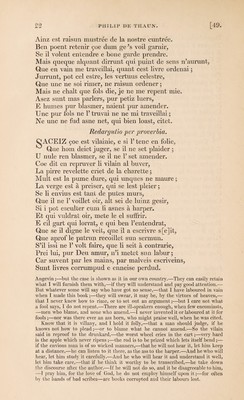
![Ainz est raisun mustree de la nostre cuntree. Ben poent retenir <.;oe dum ge *s voil garnir, Se il volent entendre e bone garde prendre. Mais queque alquant dirrunt qui puint de sens rPaurunt, Que en vain me traveillaq quant cest livre ordenai; Jurrunt, pot cel estre^ les vertuus celestre, Que unc ne soi rimeiq ne raisun ordener; Mais ne chalt que fols die, je ne me repent mie. Asez sunt mas parlers, pur petiz luers, E humes pur biasmer, naient pur amender. Unc pur fols ne l5 truvai ne ne mi traveillai; Ne unc ne fud asne net, qui bien loast, citet. Redargulio per proverbia. Q ACEIZ 90c est vilainie, e si P tenc en folie, Que liom deiet juger, se il ne set plaider; U nule ren blasmer, se il ne P set amender. Coe dit en repruver li vilain al buyer, La pirre revelette criet de la charette; Mult est la pume dure, qui unques ne maure; La verge est a preiser, qui se lest pleier; Se li envius est taut de putes murs, Que il ne P voillet oil’, alt sei de luinz gesir. Si i pot eseulter cum li asnes a harper. Et qui vuldrat oir, mete le el suffrir. E cil gart qui lorrat, e qui ben Pentendrat, Que se il digne le veit, que il a escrivre s[e]it, Que aprof le patrun recoillet sun sermun. SM issi ne P volt faire, que li seit a contrarie, Prei lui, pur Deu amur, iPi rnetet sun labur; Car suvent par les mains, par malveis escriveins, Sunt livres corrumpud e enneise perdud. Angevin;—but the case is shown as it in our own country.—They can easily retain what I will furnish them with,—if they will understand and pay good attention.— But whatever some will say who have got no sense,—that I have laboured in vain when I made this book;—they will swear, it may be, by the virtues of heaven,— that I never knew how to rime, or to set out an argument;—but I care not what a fool says, I do not repent.—There are ill-speakers enough, when few encomiasts, —men who blame, and none who amend.—I never invented it or laboured at it for fools;—nor was there ever an ass born, who might praise well, when he was cited. Know that it is villany, and I hold it folly,—that a man should judge, if he knows not how to plead;—or to blame what he cannot amend.—So the vilain said in reproof to the drunkard,—the worst wheel cries in the cart;—very hard is the apple which never ripens;—the rod is to be prized which lets itself bend;— if the envious man is of so wicked manners,—that he will not hear it, let him keep at a distance,—be can listen to it there, as the ass to the harper.—And he who will hear, let him study it carefully.—And he who will hear it and understand it well, let him take care,—that if he think it worthy to be transcribed,—he take down the discourse after the author.—If he will not do so, and it be disagreeable to him, —I pray him, for the love of God, he do not employ himself upon it;—for often by the hands of bad scribes—are books corrupted and their labours lost.](https://iiif.wellcomecollection.org/image/b29292244_0042.jp2/full/800%2C/0/default.jpg)