Popular treatises on science written during the Middle Ages, in Anglo-Saxon, Anglo-Norman, and English / Edited from the original manuscripts by Thomas Wright.
- Thomas Wright
- Date:
- 1841
Licence: Public Domain Mark
Credit: Popular treatises on science written during the Middle Ages, in Anglo-Saxon, Anglo-Norman, and English / Edited from the original manuscripts by Thomas Wright. Source: Wellcome Collection.
66/164 (page 46)
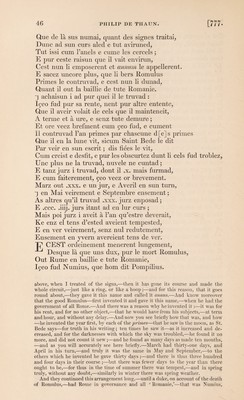
![Que cle la sus numai, quant des signes traitaq Dune ad sun curs aled e tut aviruned. Tut issi cum Panels e cume les cercels; E pur ceste raisun que il vait envirun, Cest nun li emposerent et annum le appellerent. E sacez uncore plus, que li bers Romulus Primes le contruvad, e cest nun li dunad, Quant il out la baillie de tute Romanie. q achaisun i ad pur quei il le truvad: Iyeo fud pur sa rente, nent pur altre entente, Que il aveir volait de cels que il mainteneit, A terme et a ure, e senz tute demure; Et ore veez brefment cum geo fud, e cument 11 contruvad Pan primes par chascune d[e]s primes Que il en la lune vit, sicum Saint Bede le dit Par veir en sun escrit; dis flees le vit. Cum creist e desfit, e pur les obscurtez dunt li cels fud troblez, Unc plus ne la truvad, nuvele ne cuntad; E tanz jurz i truvad, dont il .x. mais furmad, E cum faiterement, 9eo veez or brevement. Marz out .xxx. e un jur, e Averil en sun turn, q en Mai veirement e Septembre ensement; As altres qu’il truvad .xxx. jurz enposad; E .ccc. .iiij. jurs itant ad en lur curs ; Mais poi jurz i aveit a Pan quAstre deverait, Ke enz el tens d’ested aveient tempested, E en ver veirement, senz nul redutement, Ensement en yvern avereient tens de ver. P CEST ordeinement menerent lungement, Desque la que uns dux, pur le mort Romulus, Out Rume en baillie e tute Romanie, l£eo fud Numius, que horn dit Pompilius. above, when I treated of the signs,—then it has gone its course and made the whole circuit,—-just like a ring, or like a hoop;—and for this reason, that it goes round about,—they gave it this name and called it annus.—And know moreover that the good Romulus—first invented it and gave it this name,—when he had the government of all Rome.—And there was a reason why he invented it:—it was for his rent, and for no other object,—that he would have from his subjects,—at term and hour, and without any delay.—And now you see briefly how that was, and how —he invented the year first, by each of the primes—that he saw in the moon, as St. Bede says—for truth in his writing; ten times he saw it—as it increased and de¬ creased, and for the darknesses with which the sky was troubled,—he found it no more, and did not count it new;—and he found as many days as made ten months, —and as you will accurately see here briefly.—March had thirty-one days, and April in his turn,—and truly it was the same in May and September,—to the others which he invented he gave thirty days ;—and there is thus three hundred and four days in their course ;—but there was fewer days to the year than there ought to be,—for thus in the time of summer there was tempest,—and in spring truly, without any doubt,—similarly in winter there was spring weather. And they continued this arrangement long,—until a duke, on account of the death of Romulus,—had Rome in governance and all ‘ Romanie,’—that was Numius,](https://iiif.wellcomecollection.org/image/b29292244_0066.jp2/full/800%2C/0/default.jpg)