The relics of General Joseph Warren : a paper read before the New England Historical and Genealogical Society, Wednesday, November 4, 1857 / by James S. Loring.
- James Spear Loring
- Date:
- [1857]
Licence: Public Domain Mark
Credit: The relics of General Joseph Warren : a paper read before the New England Historical and Genealogical Society, Wednesday, November 4, 1857 / by James S. Loring. Source: Wellcome Collection.
Provider: This material has been provided by the National Library of Medicine (U.S.), through the Medical Heritage Library. The original may be consulted at the National Library of Medicine (U.S.)
3/10
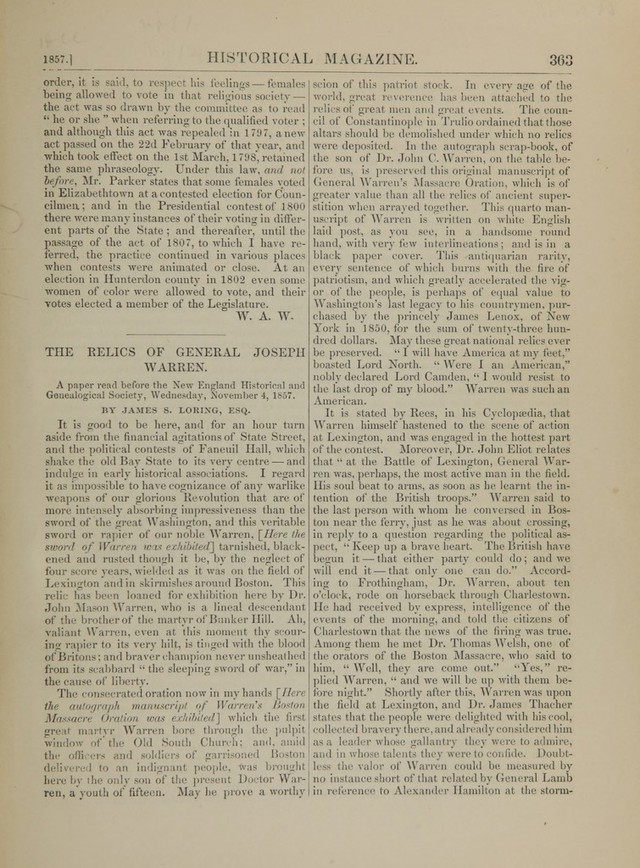
![order, it is said, to respect his feelings — females being allowed to vote in that religious society — the act was so drawn by the committee as to read he or she when referring to the qualified voter ; and although this act was repealed in 171)7, anew act passed on the 22d February of that year, and •which took effect on the 1st March, 1 798, retained the same phraseology. Under this law, and not before, Mr. Parker states that some females voted in Elizabethtown at a contested election for Coun- cilmen; and in the Presidential contest of 1800 there were many instances of their voting in differ- ent parts of the State ; and thereafter, until the passage of the act of 1807, to which I have re- ferred, the practice continued in various places when contests were animated or close. At an election in Hunterdon county in 1802 even some women of color were allowed to vote, and their votes elected a member of the Legislature. W. A. W- THE EELICS OF GENERAL JOSEPH WARREN. A paper read before the Xew England Historical and Gonealogical Society, Wednesday, November 4, 1857. BY JAMES S. LORIXG, »<,). It is frood to be here, and for an hour turn aside from the financial agitations of State Street. and the political contests of Faneuil Hall, which shake the old Bay State to its very centre — and indulge in early historical associations. I regard it as impossible to have cognizance of any warlike weapons of our glorious Revolution that are of more intensely absorbing inipressiveness than the sword of the great Washington, and this veritable sword or rapier of our noble Warren, [Here the sword of Warren was exhibited] tarnished, black- ened and rusted though it be, by the neglect of four score years, wielded as it was on the field of Lexington and in skirmishes around Boston. This relic has been loaned for exhibition here by Dr. John Mason Wan-en. wiio is a lineal descendant of the brotherof the martyr of Bunker Hill. Ah, valiant Warren, even at this moment thy scour- ing rapier to its very hilt, is tinged with the blood of Britons: and braver champion never unsheathed from its scabbard the sleeping sword of war, in thi' cause of liberty. The consecrated oration now in my hands [Here the autograph manuscript of Warren's Boston Massacre Oration was exhibited] which the first great martyr Warren bore, through the pulpit window of the Old South Church; and, amid the o'li .,■!- and soldiers of garrisoned Boston ; i an indignant people, fras broughl here by ihe only son of the present Doctor War- ren, a'youth of fifteen. May he prove a worthy scion of this patriot stock. In every age of the world, great reverence has been attached to the relics of great men and great events. The coun- cil of Constantinople in Trulio ordained that those altars should be demolished under which no relics were deposited. In the autograph scrap-book, of the son of Dr. John C. Warren, on the table be- fore us, is preserved tliis original manuscript of General Warren's Massacre Oration, which is of greater value than all the relics of ancient super- stition when arrayed together. This quarto man- uscript of Warren is written on white English laid post, as you see, in a handsome round hand, with very few interlineations; and is in a black paper cover. This antiquarian rarity, every sentence of which burns with the fire of patriotism, and which greatly accelerated the vig- or of the people, is perhaps of equal value to Washington's last legacy to his countrymen, pur- chased by the princely James Lenox, of New York in 1850, for the sum of twenty-three hun- dred dollars. May these great national relics ever he preserved. I will have America at my feet, boasted Lord North. AVere I an American, nobly declared Lord Camden, I would resist to the last drop of my blood. Warren was such an American. It is stated by Rees, in his Cyclopaedia, that Warren himself hastened to the scene of action at Lexington, and was engaged in the hottest part of the contest. Moreover, Dr. John Eliot relates that at the Battle of Lexington, General War- ren was, perhaps, the most active man in the field. His soul beat to arms, as soon as he learnt the in- tention of the British troops. Warren said to the last person with whom he conversed in Bos- ton near the ferry, just as he was about crossing, in reply to a question regarding the political as- pect, '• Keep up a brave heart. The British have begun it — that either party could do; and we will end it — that only one can do. Accord- ing to Frothingham, Dr. Warren, about ten o'clock, rode on horseback through Charlestown. He had received by express, intelligence of the events of the morning, and told the citizens of Charlestown that the news of ihe firing was true. Among them he met Dr. Thomas Welsh, one of Ihe orators of the Boston Massacre, who said to him, Well, they are come out. Yes, re- plied Warren, and we will be up with them be- fore night. Shortly after this, Warren was upon the field at Lexington, and Dr. James Thacher states that the people were delighted with his cool, collected bravery there, and already considered him as a leader whose gallantry they were to admire, and mi whose talents they were to confide. Doubt- less the valor of Warren could be measured by no instance short of that related by General Lamb in reference to Alexander Hamilton at the storm-](https://iiif.wellcomecollection.org/image/b21137717_0003.jp2/full/800%2C/0/default.jpg)