The relics of General Joseph Warren : a paper read before the New England Historical and Genealogical Society, Wednesday, November 4, 1857 / by James S. Loring.
- James Spear Loring
- Date:
- [1857]
Licence: Public Domain Mark
Credit: The relics of General Joseph Warren : a paper read before the New England Historical and Genealogical Society, Wednesday, November 4, 1857 / by James S. Loring. Source: Wellcome Collection.
Provider: This material has been provided by the National Library of Medicine (U.S.), through the Medical Heritage Library. The original may be consulted at the National Library of Medicine (U.S.)
4/10
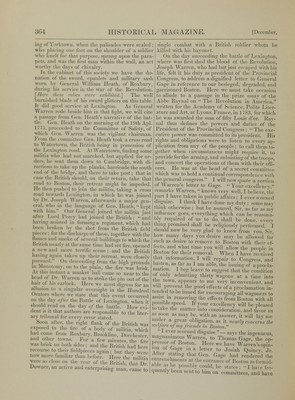
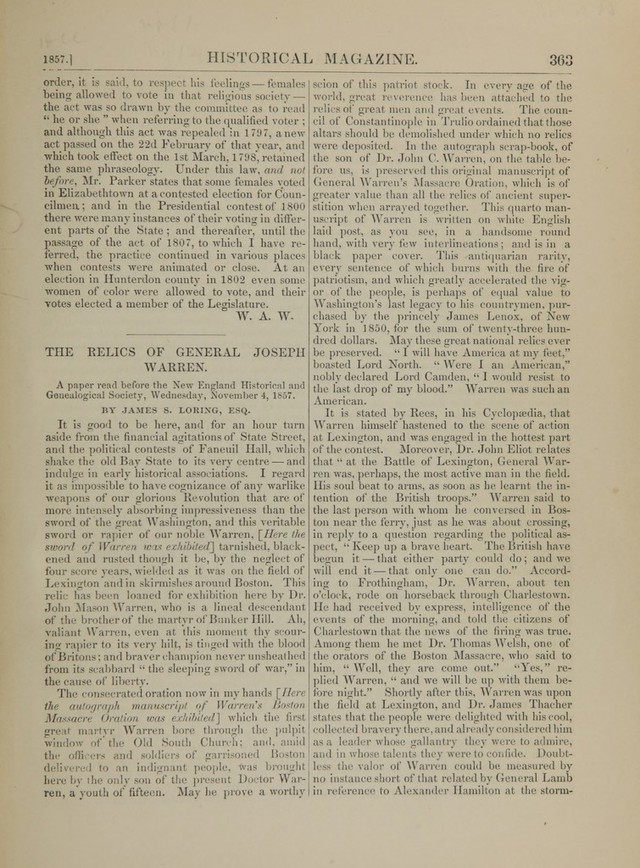
![big of Yorktown, when the palisades were scaled ; wlio placing one foot on the .shoulder of a soldier who knelt tor that purpose, sprang upon the para- pets, and was the first man within the wall, an act worthy the days of chivalry. In tlu- cabinet of this society we have the do- nation of the sword, epaulets and military sash worn by General William Heath, of Roxbury, during his service in the war of the Revolution. \Here thet were exhibited.] The well burnished blade of his sword glitters on this table. It did good service at Lexington. As General Warren rode beside him in that fight, we will cite a passage from Gen. Heath's narrative of the bat- tle. Gen. Heath on the morning of flic 19th Apl. 1775, proceeded to the Committee of .Safety, of which Gen. Warren was the vigilant chairman. From the committee (Jen. Heath took a cross road to Watertown, the British being in possession of the Lexington road. At Watertown, finding some militia who had not marched, hut applied for or- ders, he sent them down to Cambridge, with di- rections to take up the planks, barricade the south end of the bridge, and there to take post; that in case the British should, on their return, take that road to Boston, their retreat might he impeded. He then pushed to join the militia, taking a cross road towards Lexington, in which he was joined by Dr. Joseph Warren, afterwards a major gen- eral, who in the language of Gen. Heath, kept with him. Our General joined the militia just after Lord Percy had joined the British; and having^ assisted in firming a regiment, which had been broken by the shot from the British field pieces: for the discharge of these, together with the flames and smoke of several buildings to which the British nearly at the same time had set tire, opened a new and more terrific scene ; and the British having again taken up their retreat, were closely pursued. On descending from the high grounds in Menotomy, on to the plain, the fire was brisk. At this instant a musket ball came so near to the head of Dr. Warren as to strike the pin out of the hair of his earloek. Here we must digress for an allusion to a singular oversight in the Hundred Orators where we state that this event occurred on the .lay after the Battle of Lexington, when it should read on the day of the battle. How evi- dent is it that authors are responsible to the liter- ary tribunal for every error stated. Soon after, the right flank of the British was exposed to the fire of a body of militia, which had come from lioxbury, Brookline, Dorchester and other towns. For a few minutes, the fire was brisk on both sides ; and the British had here recourse to their fieldpieces again ; but they were now more familiar than before. Here the militia were SO close on the rear of the British that Dr Downer, an active and enterprising man, came to single combat with a British soldier whom he killed with his bayonet. On the day succeeding the battle of Lexington, where was first shed the blood of the Revolution, Joseph Warren, who had but just escaped with his lite, felt it his duty as president of the Provincial Congress, to address a dignified letter to General Gage in reference to our besieged, degraded, and garrisoned Boston. Here we must take occasion to allude to a passage in the prize essay of the Abbe Raynal on The Revolution in America, written for the Academy of .Science, Polite Liter- ature and Art, at Lyons, France, in 1 783, for which he was awarded the sum of fifty Louis dor. Ray- nal thus defines the powers and duties of the President of the Provincial Congress : The exe- cutive power -was committed to its president. His rights and obligations were to listen to every ap- plication from any of the people ; to call them to- gether when circumstances might require it, to provide for the arming, and subsisting of the troops, and concert the operations of them with their offi- cers. He was at the head of a secret committee which was to hold a continual correspondence with the general congress. I will now quote a portion of Warren's letter to Gage. Your excellency, remarks Warren, knows very well, I believe, the part I have taken in public affairs; I ever scorned disguise. I think 1 have done my duty ; some may think otherwise; but be assured, Sir,as far as my influence goes, everything which can be reasona- bly required of us to do, shall be done, every thing promised shall be religiously performed, 'i should now be very glad to'know from you, Sir, how many days you desire may be allowed for such as desire to remove to Boston with their ef- fects, and what time you will allow the people in Boston for their removal. When I have recen ed that information, 1 will repair to Congress, and hasten, as far as I am able, the issuing of a procla- mation. I beg leave to suggest that the condition of only admitting thirty wagons at a time into the town, appears to me very inconvenient, and will prevent the good effects of a proclamation in- tended to Ik- issued for encouraging all wagoners to assist in removing the effects from Boston with all possible speed. If your excellency will be pleased to take the matter into consideration, and favor us as soon as may be, with an answer, it will lay me under a great obligation, as it nearly concerns the welfare oj my friends in Boston. I ever scorned disguise — says the ingenuous, magnanimous Warren, to Thomas Gage, the op- pressor of Boston. Here we have Warren's opin- ion of Gage ma letter to Josiah Quincy, Jr. After stating that Gen. Gage had rendered the entrenchments at the entrance of Boston as formid- able as he possibly could, he states: -I have fre- quently been sent to him on committees, and have](https://iiif.wellcomecollection.org/image/b21137717_0004.jp2/full/800%2C/0/default.jpg)