Lexicon medicum, or, Medical dictionary : containing an explanation of the terms in anatomy, botany, chemistry, materia medica, midwifery, mineralogy, pharmacy, physiology, practice of physic, surgery, and the various branches of natural philosophy connected with medicine : selected, arranged, and compiled from the best authors / by Robert Hooper.
- Robert Hooper
- Date:
- 1832
Licence: Public Domain Mark
Credit: Lexicon medicum, or, Medical dictionary : containing an explanation of the terms in anatomy, botany, chemistry, materia medica, midwifery, mineralogy, pharmacy, physiology, practice of physic, surgery, and the various branches of natural philosophy connected with medicine : selected, arranged, and compiled from the best authors / by Robert Hooper. Source: Wellcome Collection.
Provider: This material has been provided by the National Library of Medicine (U.S.), through the Medical Heritage Library. The original may be consulted at the National Library of Medicine (U.S.)
34/894
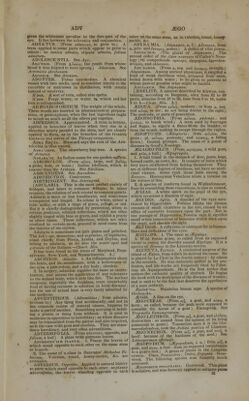
![with singular facility, and oven In the cold, this con- crete oil separated from the fatty matter ; and by heat it forms a transparent solution, which is a true soap. But no excess of ammonia can produce such an effect with spermaceti. Fourcroy concludes his memoir with some specu- lations on the change to which animal substances in peculiar circumstances are subject. In the modern chemistry, soft animal matters are considered as a com- position of the oxydes of hydrogen and carbonated azote, more complicated than those of vegetable mat- ters, and therefore more incessantly tending to altera- tion. If then the carbon be conceived to unite with the oxygen, either of the water which is present, or of the other animal matters, and thus escape in large quan- tities in the form of carbonic acid gas, we shall perceive the reason why this conversion is attended with so great a loss of weight, namely, about nine-tenths of the whole. The azote, a principle so abundant in animal matters, will form ammonia by combining with the hydrogen; part of this will escape in the vaporous form, and the rest will remain fixed in the fatty mat- ter. The residue of the animal matters deprived of a great part of their carbon, of their oxygen, and the whole of their azote, will consist of a much greater proportion of hydrogen, together with carbon and a minute quantity of oxygen. This, according to the theory of Fourcroy, constitutes the waxy matter, or adipocire, which, in combination with ammonia, forms the animal soap, into which the dead bodies are thus converted. Muscular fibre, macerated in dilute nitric acid, and afterward well washed in warm water, affords pure adipocire, of a light yellow colour, nearly of the con- sistence of tallow, of a homogeneous texture, and of course free from ammonia. This is the mode in which it is now commonly procured for chemical experiment. Ambergris appears to contain adipocire in large quantity, rather more than half of it being of this sub- stance. Adipocire has been more recently examined by Chevreul. He found it composed of a small quantity of ammonia, potassa, and lime, united to much marga- rine, and to a very little of another tatty matter differ- ent from that. Weak muriatic acid seizes the three alcaline bases. On treating the residue with a solu- tion of potassa, the margarine is precipitated in the form of a pearly substance, while theothcrfat remains dissolved. Fourcroy being of opinion that the fatty matter of animal carcasses, the substance of biliary calculi, and spermaceti, were nearly identical, gave them the same name of adipocire; but it appears from the researches of Chevreul that these substances are very different from each other. In the Philosophical Transactions for 1813, there is a very interesting paper on the above subject by Sir E. Home and Mr. Brande. He adduces many curious facts to prove that adipocire is formed by an incipient and incomplete putrefaction. Mary Howard, aged 44, died on the 12th May, 1790, and was buried in a grave ten feet deep at the east end of Shoreditch churchyard, ten feet to the east of the great common sewer, which runs from north to south, and has always a current of water in it, the usual level of which is eight feet below the level of the ground, and two feet above the level of the coffins in the graves. In August, 1811, the body was taken up, with some others buried near it, for the purpose of building a vault, and the flesh in all of them was converted into adipocire or spermaceti. At the full and new moon the tide raises water into the graves, which at other times are dry. To explain the extraordinary quantities of fat or adipocire formed by animals of a certain intestinal construction, Sir E. ob- serves, that the current of water which passes through their colon, while the loculated lateral parts are full of solid matter, places the solid contents in somewhat simitar circumstances to dead bodies in the banks of a common sewer. The circumstance of ambergris, which contains fiO per cwit. of fat, being found in immense quantities in the lower intestines of the spermaceti whales, and nevei higher up than seven feet from the anus, is an ihie proof of fat being formed in the intestines; and a/ ambergris is only met with in whales out of health it is most probably collected there from the ab- Borbente, under the influence of disease, not acting so as to take it into the constitution. In the human 30 colon, solid masses of fat are sometimes met with in a ed state of that canal. A description and analysis by Doctor I re of a mass of ambergris, extracted in Perthshire from the rectum of a.living woman, were published in a London Medical Journal in September, 1817. There is a case communicated by Dr. BabingtOD, of fat formed in the intestines of a girl four and a half years old, and passing off by stool. Mr. Brande found, on the suggestion of Sir E. Home, that muscle digested in bile, is convertible into fat, at the temperature of about 100°. If the substance, however, pass rapidly into putrefaction, no fat is formed. Fa:ces voided by a gouty gentleman after six days' constipation, yielded, on infusion in water, a fatty film. This process of forming fat in the lower intestines by means of bile, throws considerable light upon the nourishment de- rived from clysters, a fact well ascertained, but which could not be explained. It also accounts for the wast- ing of the body, which so invariably attends all com- plaints of the lower bowels. It accounts too for all the varieties in the turns of the colon, which we meet with in so great a degree in different animals. This property of the bile explains likewise the formation of tatty concretions in the gall bladder so commonly met with, and which, from these experiments, appear to be produced by the action of the bile on the mucus secreted in the gall bladder; and it enables us to understand how want of the gall bladder in children, from mal-formation, is attended with excessive lean- ness, notwithstanding a great appetite, and leads to an early death. Fat thus appears to be formed in the intestines, and from thence received into the circu- lation, and deposited in almost every part of the body. And as there appears to be no direct channel by which any superabundance of it can be thrown out of the body, whenever its supply exceeds the consumption, its accumulation becomes a disease, and often a very distressing one. [In the New-York Medical Repository, vol. ii. p. 325, is related the case of a person who was drowned, and whose body was converted into this substance after lying in the mud of a river for a year. We have seen a piece of meat raised out of a well by pumping, into which it had fallen, and where it was completely changed into adipocire. A barrel of meat, which had undergone a change and become adipocire, was raised from the British frigate Hussar, sunk near Hell-Gate during the revolutionary war, where it had remained in eight or ten fathoms of salt water near fifty years. A single body of a female, consisting of a solid mass of adipocire, was dug up in dry ground, near the City Hall in New-York. A box of candles, taken from a sunken wreck on the coast of Brazil, was changed in appearance and consistence, and had become a mass of adipocire. The bones of a huge cetaceous animal were dug up in the low grounds about New-Orleans; when they were exhibited as a show in New-York, in 1828, adipocire was discovered in the cells of the spongy part of the jaw-bone. A.] ADIPOSE. (Adiposus; from adeps, fat.) Fatty as adipose membrane, &c. Adipose membrane. Membrana adiposa. The fat collected in the cells of the cellular membrane. ADI'PSA. (From a, neg. and it\pa, thirst.) i. So the Greeks called medicines, &c. which abate thirst. 2. Hippocrates applied this word to oxymel. ADI'PSIA. (From a, neg. and Stipa, thirst.) A want of thirst. A genus of disease in the class locales and order dysorcxicc of Cullen's Nosology. It jg mostly symptomatic of some disease of the brain. ADI'PSOS. So called because it allays thirst.) I. The Egyptian palm-tree, the fruit of which is said to. be the .Myrobaluns, which quench thirst. 2. Also a name for liquorice. ADJUTO'RIUM. (From ad and juvo, to help.) A name of the humerus, from its usefulness in lifting up the fore-arm. ADJUVA'NTIA. Whatever assists in preventing or curing disease. Adnata tunica. Mbvginea oculi; Tunica albu- ginea oculi. A membrane of the eye mostly confound- ed with the conjiinciiiin. It is, however, thus formed • five of the muscles which move the eye, take their ori- gin from the bottom of the orbit, anil the sixth arises from the edge of it; they are all inserted by a tendi- nous expansion, into the anterior part of the tunica sclerotica] which expansion forms the adnata and](https://iiif.wellcomecollection.org/image/b21129599_0034.jp2/full/800%2C/0/default.jpg)
 No text description is available for this image
 No text description is available for this image
 No text description is available for this image