Intestinal obstruction : its varieties with their pathology, diagnosis, and treatment / by Frederick Treves.
- Sir Frederick Treves, 1st Baronet
- Date:
- 1884
Licence: Public Domain Mark
Credit: Intestinal obstruction : its varieties with their pathology, diagnosis, and treatment / by Frederick Treves. Source: Wellcome Collection.
Provider: This material has been provided by the Augustus C. Long Health Sciences Library at Columbia University and Columbia University Libraries/Information Services, through the Medical Heritage Library. The original may be consulted at the the Augustus C. Long Health Sciences Library at Columbia University and Columbia University.
31/534 page 17
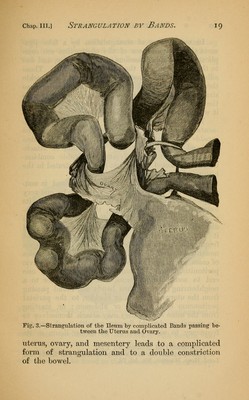
![may be produced by the very localised peritonitis that is sometimes associated with caseous degeneration of a mesenteric gland. I have met with several re- ported cases, and not a few specimens, that illustrate this circumstance. A single adhesion may readily follow upon the little speck of peritonitis that often attends an intestinal ulcer (Fig, 20). As the ulcer deepens it excites an inflammation over a very limited area of the serous surface. This inflamed spot adheres to some other point on the peritoneum ; a single adhesion forms, which, becoming elongated by the method already described, forms an example of the solitary band. A great many of the cases of solitary band described are evidently instances of strangulation by Meckel's diverticulum, or by a diver- ticular ligament. In some few cases there have been two or more false ligaments found in the abdominal cavity. , Some- times these would a})pear to have been produced by the thrusting of a coil of intestine through a broad peritoneal adhesion so as to divide it into two seg- ments. In other instances the bands are inde])endent of one another. Mr. Berkeley Hill reports a case of acute intestinal obstruction where two bands existed, both of which constricted knuckles of small intestine. One constriction was, however, comparatively slight, the other was severe. Laparotomy was performed, and unfortunately the band found and divided was that associated with the minor obstruction. The more serious strangulation was overlooked and the child died. The adhesions in this case appear to have been due to mesenteric gland disease.* The false ligament, although single, may have a complicated arrangement, and lead to extraordinary forms of constriction of the bowel. Thus in the * Lancet, vol. i., 1876, page 773. 1 ^ -1 A<](https://iiif.wellcomecollection.org/image/b21205528_0031.jp2/full/800%2C/0/default.jpg)