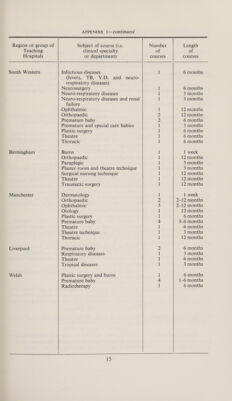
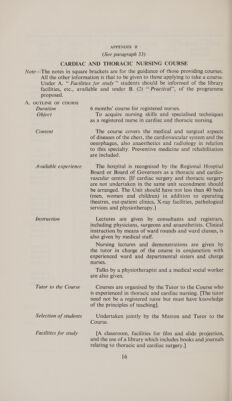
The post-certificate training and education of nurses / [report by a Sub-Committee of the Standing Nursing Advisory Committee].
- Great Britain. Standing Nursing Advisory Committee. Sub-Committee on the Post-Certificate Training and Education of Nurses.
- Date:
- 1966
Licence: Public Domain Mark
Credit: The post-certificate training and education of nurses / [report by a Sub-Committee of the Standing Nursing Advisory Committee]. Source: Wellcome Collection.
19/32 (page 11)
![46. Boards of Governors, like Hospital Management Committees, would have the responsibility for the in-service training of their nursing staff. For post- certificate training it would be best for them to participate in regional arrange- ments and to be represented on Regional Steering Committees. If teaching hospitals were to organise their own post-certificate training independently, this might conflict with the efforts of Regional Boards and Hospital Management Committees, especially as regards clinical courses. 47. Other educational institutions. There can be distinguished :— (a) institutions whose educational activity originates in their interest in nursing—for example, the Royal College of Nursing and the King Edward’s Hospital Fund; (5) those such as the universities and technical colleges, whose interest in nursing arises from their educational activity. Each class has a distinctive role, but both can give valuable support to the Regional Boards in their educational activities. 48. Those in the first class have been the pioneers of nursing education and have generated interest and activity in those of the second, as well as in hospital authorities. We hope they will continue their efforts, especially in reviewing the changing needs of the nursing profession and devising new courses to meet them, either directly or through other agencies. With the expansion of post- certificate training it may be expected that, while expanding their present efforts, they will provide a proportionately smaller part of total facilities than at present. In the long term the provision of shorter courses of preparation of Ward Sisters might have repercussions on the 3-month Ward Sisters’ courses provided by the Royal College of Nursing and the King Edward’s Hospital Fund. It may be that in the future they would be developed into courses of preparation for a level higher than that of Ward Sister: in the meantime they will continue to serve a most useful purpose. 49. Some educational institutions, such as technical colleges, could take a larger share in post-certificate training than in the past. This is in accordance with the trend of increased participation by them in vocational training formerly given by professional institutions. The extent to which advantage is taken of this would depend largely on the initiative of professional organisations and of hospital authorities. As regards professional nursing subjects, the role which many technical colleges can play is probably limited to providing accom- modation, with tutorial staff coming from the hospitals; but they can provide courses on general subjects and might be able to assist by means of day-release courses. The part which universities can play in post-certificate training up to the level of Ward Sister is likely to be limited because at this level, for the most part, short courses only are needed. 50. National co-ordination. We have considered whether there is scope for a new national body to control post-certificate training and education. There are a number of functions for such a body—to determine the clinical specialties in which clinical courses are desirable; to lay down national standards to be met by hospitals providing courses; to control the syllabuses for courses; to 1]](https://iiif.wellcomecollection.org/image/b32178517_0019.jp2/full/800%2C/0/default.jpg)