Observations relating to the transmission of sleeping sickness in Uganda, the distribution and bionomics of Glossina palpalis, and to clearing measures / by Aubrey D.P. Hodges.
- Hodges, Aubrey Dallas Percival, 1861-1946.
- Date:
- 1909
Licence: In copyright
Credit: Observations relating to the transmission of sleeping sickness in Uganda, the distribution and bionomics of Glossina palpalis, and to clearing measures / by Aubrey D.P. Hodges. Source: Wellcome Collection.
Provider: This material has been provided by The Royal College of Surgeons of England. The original may be consulted at The Royal College of Surgeons of England.
28/30 page 26
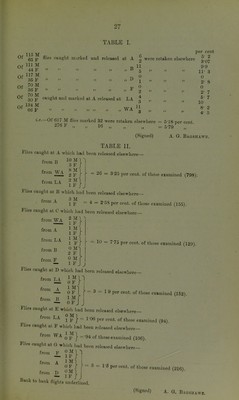
![interfering with the vegetation and afterwards to determine tlie influence of various degrees of clearing. Sncli a procedure wonld take time but is calculated to lead to tliat precise knowledge winch we at ])resent lack. (Signed) A. G. IIagsiiawe. [Note.]—It is worth noting that while of 1,521 flies caught at A, r>, II, E, F and G only 478 were female, of 129 caught at C 66 were of that sex. These figures and others in my possession lead me to suspect that as a rule where female flies are found in excess the breeding grounds must be looked for at a distance. Thus at Harubale (Lake Kuisamba) females were on every occasion in excess: of 1,420 Hies caught in tlie first series of flight experiments 827 were female. When, however, I found the chief breeding ground, some hundred yards from tlie scene of previous captures, I caught very quickly 61 male and 45 female Hies. At a bridge over the Mpanga river, much used by caravans, Hy were scarce but females relatively numerous, 59 to 16 male. It is certain that this spot was far from a breeding ground, perhaps three miles. Eeferring to my notes of the flies caught at the spots where pupae were found I find that, in every case but one, males were in excess and as a rule were as two to one. Probably the female must be well supplied with blood to enable her to nourish her larva; if there is scarcity she must go far afield to procure it. The male could exist with less food and need not range so widely. This is not so unimportant as at first appears for in clearing it should be our aim to attack the breeding grounds ; the sex proportion, if it has the significance which I suggest, will assist us to find them. ]\Iy figures are too small, my data too few, to prove anything; other observers wiU, it is to be hoped, follow up these suggestions.—A.G.B.](https://iiif.wellcomecollection.org/image/b2241972x_0030.jp2/full/800%2C/0/default.jpg)
 No text description is available for this image
 No text description is available for this image
 No text description is available for this image