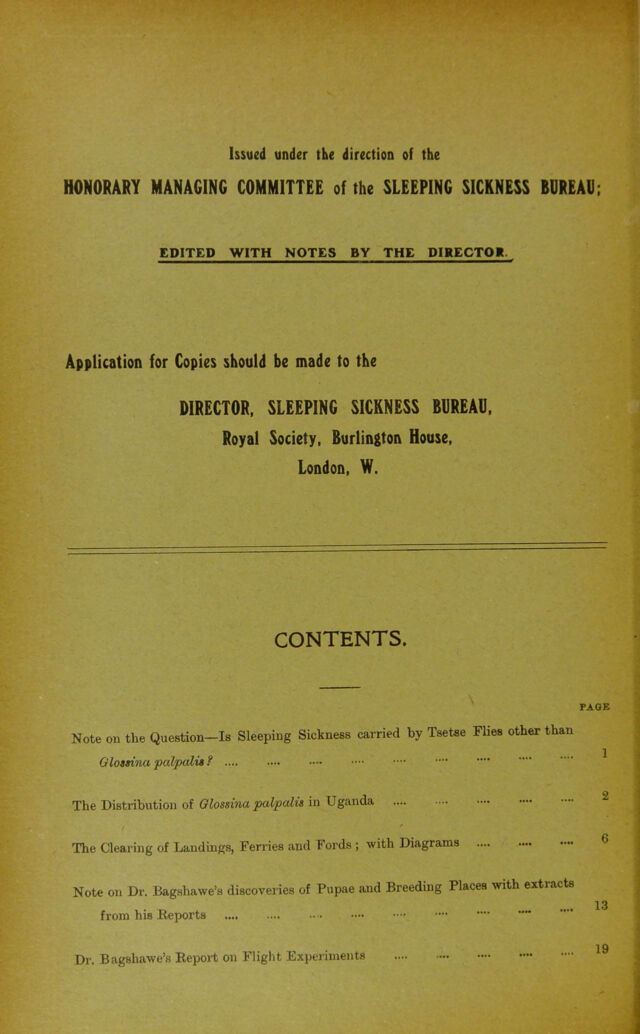
Observations relating to the transmission of sleeping sickness in Uganda, the distribution and bionomics of Glossina palpalis, and to clearing measures / by Aubrey D.P. Hodges.
- Hodges, Aubrey Dallas Percival, 1861-1946.
- Date:
- 1909
Licence: In copyright
Credit: Observations relating to the transmission of sleeping sickness in Uganda, the distribution and bionomics of Glossina palpalis, and to clearing measures / by Aubrey D.P. Hodges. Source: Wellcome Collection.
Provider: This material has been provided by The Royal College of Surgeons of England. The original may be consulted at The Royal College of Surgeons of England.
4/30 page 2
![Personally, therefore, I remain of the opinion that the species morsilanH, 2mllidipes and fusca are not likely to carry infection, unless occasionally and by chance, as a needle or a thorn might, and under specially favourable conditions such as interrupted feeding. It does not seem probable that their presence would cause or seriously influence an epidemic; nor do I see any need to suppose the existence of any other means of spreading infection among human beings than the bite of G. 2)a,l2^alis* (Signed) A. ]). P. Hodges. NOTE ON THE DISTEIBUTION OF GLOSSINA PALPALIS. The mapping of the general distribution of G. palpalis in the Uganda Protectorate may be said, broadly speaking, to be complete. The examina- tion of minuter details in special localities will still from time to time be required for special purposes, but the main facts, with a very large amount of local detail, have been ascertained and recorded. The general distribution may be taken as practically constant, but the local distribution varies within certain limits, and the conditions governing local variations require further investigation. We know now the distribution as described by a single observer in each region in one set of conditions or season of the year. What is now required for complete detailed knowledge is a re-examination under different conditions by the same or other observers. In this way com- parison could be made which would give us the variations in seasonal prevalence and under improved conditions of clearing etc. The seasonal variation of G. palpalis in numbers and distribution is as yet little known, but in some localities it is probably considerable, chiefly so along the banks of rivers and water-courses, f Along the shores of lakes the physical conditions affecting the fly are much less subject to change with the seasons, whereas water-courses may be full or dry, at low w'ater or in flood—the conditions, especially at the water’s edge, varying much with the height of the water-level and the width of the contained stream. * At a place near the Victoria Nile I met •with Q-. morsitans and palhdipes for the first time. I made the following note :—“ I was struck by the '»vay in which the flies pestered us. I was bitten several times, three times in the palm. These flies settled quickly and settled to bite, whereas &. palpalis often alights on a clothed part of the body and even when it settles on skin is in no hurry to puncture and often seems to be merely resting. I 'was bitten more in three hours than by O. palpalis in the whole course of these investigations. I cannot say which was the species which attacked us so pertinaciously, as I did not the time recognise that there was more than one. The observation supports Dr. Hodges argu- ment that these species do not spread the disease. t Along the shores of lakes such ns the Albert, where there is a well-defined dry season, the leaves of many shrubs become wilted or are dropped when the hot ■weather has set in. Ihe amount of shade afforded becomes less and probably the conditions for breeding are not so favourable as in Ihe rains. On the north west shore of the Victoria Nyanzn, including the islands, there is no definite drj' season and the shade conditions remain unchanged through- out the year.](https://iiif.wellcomecollection.org/image/b2241972x_0006.jp2/full/800%2C/0/default.jpg)