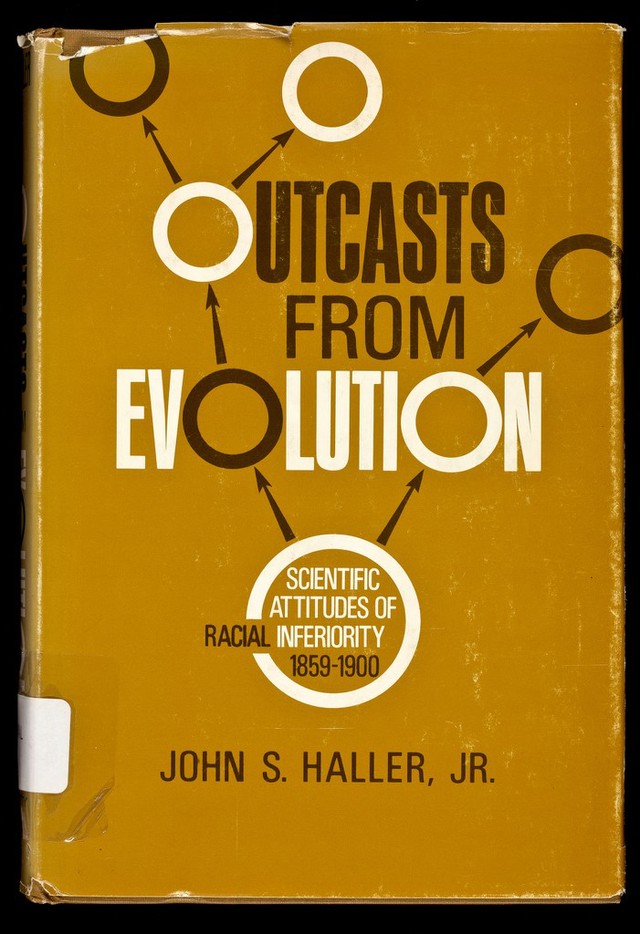
Outcasts from evolution : scientific attitudes of racial inferiority, 1859-1900 / John S. Haller, Jr.
- Haller, John S., Jr., 1940-
- Date:
- [1971]
Licence: Attribution-NonCommercial 4.0 International (CC BY-NC 4.0)
Credit: Outcasts from evolution : scientific attitudes of racial inferiority, 1859-1900 / John S. Haller, Jr. Source: Wellcome Collection.
42/256 page 22
![22 • Outcasts from Evolution The whole basis of Quetelet's researches was the creation of an average man as representative of specific groups and an analysis of that specimen in his various relations, physical, social and mor al. Drawing statistics and relationships out of a multitude of exami¬ nations of soldiers, the Sanitary Commission sought to construct Quetelet's average man. In finding him among the native Ameri¬ can, British American, English, Irish, German, foreigner, Negro, Indian, and college student, the commission determined profiles of an abstract man to whom they assigned a statistical intellect, capacity, judgment, and tendency. It was a study oriented from its very inception upon a proper understanding of the varieties of man—a reflection of the reformer's zeal in the early years of an¬ thropology in America. Indeed the external form of this average man may legitimately be adopted as a standard of beauty and a model for art. The eminent scien¬ tist already named [Quetelet] has shown that we may discover not merely the outward semblance of this abstract being, but his needs, capacities, intellect, judgement, and tendencies; and Quetelet may thus be regarded as the founder of statistical anthropology, indeed of social science, in the true significance of the word, according to which science depends upon the investigation of laws, not upon the consideration of isolated facts, nor the dissemination of correct principles.^® In July, 1864, the Sanitary Commission invited Benjamin A. Gould, a member of the National Academy of Sciences and presi¬ dent of the American Association for the Advancement of Science, to assume direction of extension of the anthropometric statistics undertaken in 1863 by Ezekiel B. Elliott, the commission's first actuary.^® In the reports of the Sanitary Commission published in Gould, Investigations, 244; Howard Becker and Harry E. Barnes, Social Thought from Lore to Science, 2 vols. (Washington, D.C., 1952), I, 563; Quetelet, A Treatise on Man, 74; Franz Boas, Remarks on the Theory of Anthropometry, American Statistical Association, Proceedings, HI (Dec., 1893), 569-75. Gould, Investigations, 246; Edward B. Tylor, Quetelet on the Science of Man, Popular Science Monthly, I (May, 1872), 45-55. Gould, Investigations, v; Erving Winslow, Sketch of Professor Benjamin Gould, Popular Science Monthly, П (Mar., 1882), 683-87; Ezekiel B. Elliott, Preliminary Report on the Mortality and Sickness of Volunteer Forces of the United States Government during the Present War (New York, 1862); Death of E. B. Elliott, Science, XI (June, 1888), 261.](https://iiif.wellcomecollection.org/image/b18025729_0043.JP2/full/800%2C/0/default.jpg)