Catalogue of the Oriya manuscripts in the Library of the India Office / by James Fuller Blumhardt.
- Great Britain. India Office. Library
- Date:
- 1924
Licence: Public Domain Mark
Credit: Catalogue of the Oriya manuscripts in the Library of the India Office / by James Fuller Blumhardt. Source: Wellcome Collection.
20/38 (page 8)
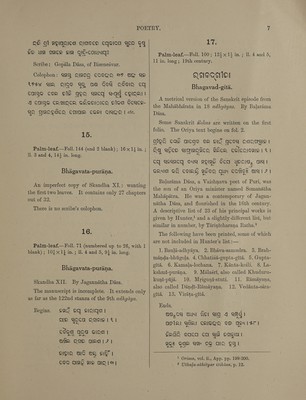
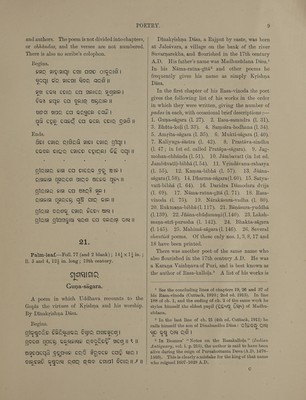
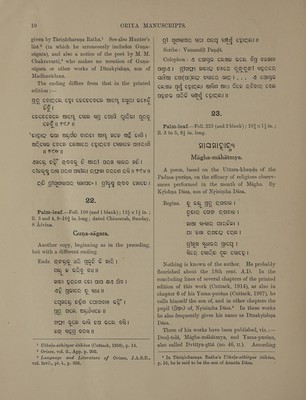
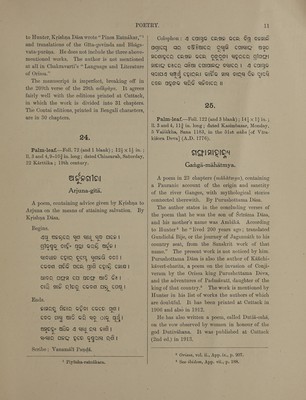
![gay Qm@ CAIs’ J CA 9H AQGIA! am Qa COG QCA QMQIN GIQI KS] The manuscript has no colophon. 18. Palm-leafi—Foll. 99 (paged up to 71, with 1 blank); 11} x 12 in. ; ll. 3 and 4, 10 in. long. Bhagavad-gita. Another copy, similar to the above, also without scribe’s colophon. 19. Palm-leaf—Foll. 107 ; 1331} in. ; Il. 4, 124 in. long ; dated Padyabati, 29 Karkata, in the 24th anka of Virakisora Deva. NANI ny Gupta-gita. A metaphysical and ethical poem, in 33 adhyayas, in the form of a discourse between Krishna and Arjuna. By Balaréima Dasa. Begins. Yen As GQ Mm | CAH, AQ QAQMI | @ I seq O00 Smit QQQ IMQIA AAI F | HQIG AUCQ CAQ AQ | OH AQR COMPAQ | | H! 91 ala aagia | n~ DIA NASI, QAI v | Ends. 9Q89 4c CH Aloo | CAQAINGA ID QHAI Te | QAUIAINGRHR AQH AG AQ AMQIA VIA Ol QAI QQQ MPQIA TIA! COE Adal CQRI CAAITI | ~ QO Alygdel gan qq ggg@aul gl callsiciig a1 99 age agica amid cBga gach sis endicaietigs Scribe: Colophon: A1gq QAQ ela Catladag aA1e10- CQYQ COP AVIAIMIGR MH IQ QIchy AAg ISQ UG HG Qel asider Gem gloci og CAINDIQN OQGA Ea com aa aS olcg cq CAIAG siIAP! AQUDE ean OIGQ J calge atc] cQai cq calge spol ae tai QIUOGAQ IACQ CSMOGA QCA | Govardhana Ratha, of Ramchandrapur. 20. Palm-leaf.—Foll. 304 (and 8 blank), 174 x 1} in. ll. 3 and 4, 134-15 in. long; written PaO in the 19th century. DAG] QAI Vilanka-Ramayana. By Balarama Dasa, son of Bhagirathi Dasa. The work is generally regarded as forming a supplementary kanda to the Oriya Ramayana. It contains a metrical account of the battle between Rama and Ravana at an imaginary city called Vilanka, and differs from the account in the Sanskrit epic in that it is written in special glorification of Sita, who, as an apotheosis of the goddess Kali, is represented as the slayer of the demon Ravana. The story appears to be a popular one, as three versions have been printed; one by Sarala Dasa, author of the Oriya Mahabharata, another by Vardnidhi Dasa, and the third by Siddhegvara Dasa. The present work by Balarama Dasa does not appear to have been published. The author states at the conclusion of the poem that he was the son of Bhagirathi Dasa, and his mother’s name was Sriya. No mention is made of him, or of this, or of any of the printed versions of the story, in any of the works on Oriya literature](https://iiif.wellcomecollection.org/image/b32179297_0020.jp2/full/800%2C/0/default.jpg)