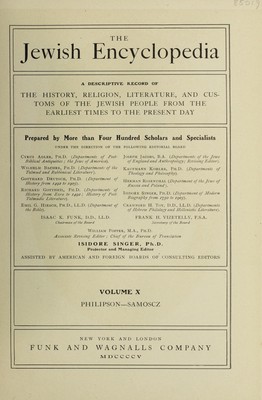
Volume 10
The Jewish encyclopedia : a descriptive record of the history, religion, literature, and customs of the Jewish people from the earliest times to the present day / prepared ... under the direction of ... Cyrus Adler [and others] Isidore Singer ... managing editor.
- Date:
- 1901-1906
Licence: In copyright
Credit: The Jewish encyclopedia : a descriptive record of the history, religion, literature, and customs of the Jewish people from the earliest times to the present day / prepared ... under the direction of ... Cyrus Adler [and others] Isidore Singer ... managing editor. Source: Wellcome Collection.
15/728
![SYSTEMS OF TRANSLITERATION AND OF CITATION OF PROPER NAMES A.—Rules for the Transliteration of Hebrew and Aramaic. 1. All important names which occur in the Bible are cited as found in the authorized King James version; e.g., Moses, not Mosheh; Isaac, not Yizhak; Saul, not Sha’ul or Shaiil; Solomon, not Shelomoh, etc. 2. The spellings of names that have gained currency in English books on Jewish subjects, or that have become familiar to English readers, are generally retained ; cross-references are given when topics are treated under forms transliterated according to the system tabulated below. 3. Hebrew subject-headings are transcribed according to the scheme of transliteration ; cross-refer- ences are made as in the case of personal names. 4. The following system of transliteration has been used for Hebrew and Aramaic ; X Not noted at the beginning or the end of a loord ; otheridse ’ or by dieresis; e.g., pe'er or Me'ir. 3 b r 2 h 1 Q {with dagesh), p C' sh i 9 n h O m D {ivithout dagesh), f s n d 0 t j n V ? n t n h ' V D s P k 1 w D k y ‘ -| r Note ; The presence of dagesh lene is not noted except in the case of C. Dagesh forte is indi- cated by doubling the letter. 5. The vowels have been transcribed as follows : — (kamez) a — u — (kamez liatuf) o “ a — e i 0 ~ e — e — 0 ' — i — i — e — a ^ u The so-called “Continental” pronunciation of the English vowels is implied. 6. The Hebrew article is transcribed as ha, followed by a hyphen, without doubling the following letter. [Not hak-Kohen or hak-Cohen, nor Rosh ha-shshanah.] B.—Rules for the Transliteration of Arabic. I. All Arabic names and words, except such as have become familiar to English readers in other forms, as Mohammed, Koran, mosque, are transliterated according to the following system : ^ Se'> s* above ^ kh 0 d J d/t ^ «■ th J '■ L t ^k ^ y nj ) ^ Is ? J ' XL \J^s ^ ^ ^ m the three vowels — a, i, u—are represented: / a — * -L. U No account has been taken of the imalah; i has not been written e, nor u written o. * In all other matters of orthography the spelling preferred hy the Standarb Dictionary has usually been followed. Typo- graphical exigencies have rendered occasional deviations from these systems necessary.](https://iiif.wellcomecollection.org/image/b29000488_0010_0017.jp2/full/800%2C/0/default.jpg)