Volume 1
The Jewish encyclopedia : a descriptive record of the history, religion, literature, and customs of the Jewish people from the earliest times to the present day / prepared ... under the direction of ... Cyrus Adler [and others] Isidore Singer ... managing editor.
- Date:
- 1901-1906
Licence: In copyright
Credit: The Jewish encyclopedia : a descriptive record of the history, religion, literature, and customs of the Jewish people from the earliest times to the present day / prepared ... under the direction of ... Cyrus Adler [and others] Isidore Singer ... managing editor. Source: Wellcome Collection.
175/752 (page 127)
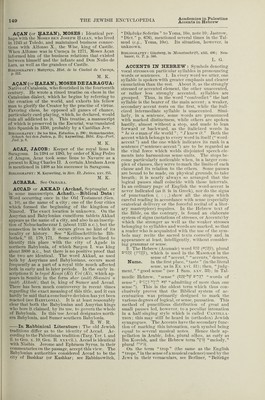
![Abrams, Harriet Abravanel and when scarcely twenty years old wrote on tlie original form of tlie natural elements, on the most vital religious questions, on prophecy, etc. His po- litical abilities also attracted attention while he was still young. He entered the service of King Alfonso V. of Portugal as treasurer, and soon won the con- fidence of his master. Notwithstanding his high posi- tion and the great wealth he had inherited from his father,his love for his afflicted brethren was unabated. When Arzilla, in Morocco, was taken by the Moors, and the Jewish captives were sold as slaves, he con- tributed largely to the funds needed to manumit Abravanel Coat of Arms. (From the Archives of the Amsterdam Portuguese Congregation.) them, and personally arranged for collections throughout Portugal. He also wrote to his learned and wealthy fricml Jehiel, of Pi.sa, in behalf of the captives. After the death of Alfonso he 'was obliged to relinquish his office, having been accused by King John H. of connivance with the duke of Bra- gan^a, who had been executed on the charge of con- sjiiracy. Abravanel, warned in time, saved himself by a hasty flight to Castile (1483). His large for- tune was confiscated by royal decree. At Toledo, his new home, he occupied himself at first with Bib- lical studies, and in the course of six months jiroduccd an extensive commentary on the books of Joshua, Judges, and Samuel. But shortly afterward he en- tered the service of the house of Castile. Together with his friend, the influential Don Abraham Senior, of Segovia, he undertook to farm the revenues and to supply provisions for the ro3'al armj', contracts that he carried out to the entire satisfaction of Queen Isiibella. During the Moorish w'ar Abravanel ad- vanced considerable sums of money to the govern- ment. When the banishment of the Jews from Spain was decreed, he left nothing undone to induce the king to revoke the edict. In vain did he offer him 30.000 ducats (868,400, nominal value). AVith his brethren in faith he left Spain and went to Naples, where, soon after, ho entered the service of the king. For a short time he lived in peace undisturbed; but when the citj^ was taken by the P'rench, bereft of all his possessions, he followed the 3'oung king, Ferdinand, in 1495, to jMessina; then went to Corfu; and in 1496 settled in Aloiiopoli, and lastly (1503) in Venice, where his services were emplo3'ed in nego- tiating a commercial treaty between Portugal and the Venetian republic (Zurita, “Historia (lei Bey Don Fernando el Catolico,” v. 342c). AI. K. Abravanel’s importance, however, lies not only in his changeful and active career. Although his works can scarcely be said to be of an ab.solutely original character, they contain so much instructive material, and exerted so wide an influence, fhat the3' demand special attention. They ma3' be divided into three classes, referring to (1) exegesis, such as his com- mentary upon the entire Bible with the exception of the Hagiographa; (2) philosoph3', dealing with philosophy in general and particularl3’ with that of the Jewish religion; (3) apologetics, in defense of the Jewish doctrine of the Messiah. Characteristic of Abravanel’s exegetic writings is his accurate esti- mation of the historical standpoint in As Author the ancient annals of tlie Jewish peo- and Exe- pie. All preceding Jewish cxegetes gete. had been too far removed from the tumult of the great world to po.ssess a proper estimate of the historical ejiochs and epi- sodes described in Scripture. Abravanel, who had himself taken part in the politics of the great pow- ers of the da3', rightly perceived that mere consider- ation of the literary elements of Scripture was in- sufficient, and that the political and social life of the people must also be taken into account. He recog- nized also the value of prefacing the individual books of the Bible with a general introduction con- cerning the character of each book, its date of com- position, and the author’s intention ; he ina3'conse- quently be considered as a pioneer of the modern science of Bible propaalcutics. These excellences of Abravanel's commentaries were esiieciallv ap- preciated 1)3' the Christian scholars of the seven- teenth and eighteenth centuries. No less than thirty Christian writers of this period—among them men of eminence, like the younger Buxtorf, Bnddeus, Carpzov, and others—oecui)ied themselves with the close study of Abravanel’s cxegetical writings, which they condensed and translated, and thus introduced to the world of Christia'i seholarsliii). Fossibh' somewhat of this ap- preciation of Abra- vanel by Christians was due to the latter’s tolerance toward the Christian cxegetes— Jerome, Augustine, and Nicholas de Lyra —all of whom were closely studied by him and (juoted without prejudice, receiving I’lnuse or disapprobation as the case demanded. Abravanel’s Jew- ish predecessors in the reidm of j)hiloso- ph3', whoever, by no means received the same amount of tolerance at his hands. Alen like Albalag, Pal(|uera, Geisonides, Narboni, and others, were rounclly denounced by Abravanel as infidels and misleading guides, for ven- turing to assume a comparatively liberal standpoint in religio-philosophical questions. Although he was the last Jewish Aristotelian, Abravanel was essentiall3'an opponent of philosojiln', for his entire concejition of Judaism, opposed to that of Alaimon- As Phi- ides and his school, was rooted in a losopher. firm conviction of God’s revelation in history, and jiarticularly in the history of the selected ]ieo]ile. Had Abravanel not been misled by the “ Guide ” of Alaimonides, for whom ho shared the traditional veneration, he might have Isaac AUravanel. (Traditional portrait.)](https://iiif.wellcomecollection.org/image/b29000488_0001_0177.jp2/full/800%2C/0/default.jpg)