Volume 1
The Jewish encyclopedia : a descriptive record of the history, religion, literature, and customs of the Jewish people from the earliest times to the present day / prepared ... under the direction of ... Cyrus Adler [and others] Isidore Singer ... managing editor.
- Date:
- 1901-1906
Licence: In copyright
Credit: The Jewish encyclopedia : a descriptive record of the history, religion, literature, and customs of the Jewish people from the earliest times to the present day / prepared ... under the direction of ... Cyrus Adler [and others] Isidore Singer ... managing editor. Source: Wellcome Collection.
177/752 (page 129)
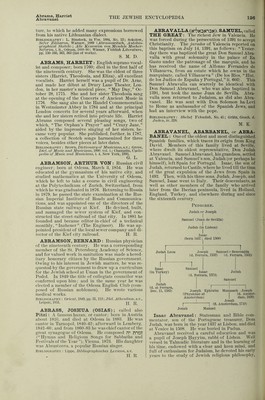
![Abraxas he died Feb. 19, 1707. 3. Son of Manasseh Abra- vanel; was a member of the Talmudical Academy ‘Ez Hayyim in Amsterdam, 1710. josepk Abravanel: 1. Physician and scholar; sou of Isaac Abravanel; born at Lisbon in 1471; died about 1552. He lived at Venice and later at Ferrara, and enjoyed a great reputation. 2. A physician, brother of Manasseh Abravanel; flour- ished at Amsterdam in the seventeenth century; died about 1620. 3. A member of the Academy I ‘Ez Hayyim at Amsterdam, in 1706. I Judah, Abravanel: 1. Receiver of customs at Seville, Spain, in 1310. He rendered substantial 1 service to the grandees of Castile. The infante Don I Pedro, in his will, dated Seville, May 9, 1317, or- 1 dered that Judah be paid: (1) 15,000 maravcdis (§36,000) for clothes delivered ; (2) 30,000 mara- vedis (§72,000) as part of a personal debt, at the same time requesting Judah to release him from paying the rest. Judah had been in great favor with King Alfonso the Wise, with whom he once had a conversation regarding Jews and Judai.sm. 2. Grandson of the preceding; Portuguese treas- urer about 1400. He managed the financial af- fairs of the infante Dom Fernando, who assigned to him, in 1437, over half a million reis blancos. 3. See Leo IlEBRaius. 4. The grandson of Judah Abravanel, or Leo Hebraeus, bore also the name of Judah. He was a much respected man, who died Dec. 15, 1583, at Ferrara, at the age of fifty. He lived with his brother Jacob Abravanel and another Judah Abravanel, who was renowned for his wealth and for Iris philanthropy. Samuel Abravanel: Sou of Judah Abravanel of Seville; settled in Castile. He became a patron of learning. He supported the scholar, Menahem ben Zerah, and had him elected rabbi of Toledo. As a mark of his gratitude Menahem dedicated to Abravanel his work, “ Zedah la-Derek ” (Provision for the Journey). During the persecution of 1391 he submitted to baptism and was named, according to Zacuto, Juan of Seville. He soon, however, re- turned to Judaism. See also Abr.vvalla, Samuel. Samuel Abravanel: Youngest son of Isaac Abravanel, and grandson of Judah; was born in 1473, at Lisbon. His father sent him to Salonica to pursue his Talmudic studies, where he became the pupil of Joseph Fasi. He lived at Naples, and was employed as financier by the viceroy Don Pedro de Toledo. He made the best possible use of his great wealth, which amounted to more than 200,000 gold zecchini or sequins (about §450,000). The poet Samuel Usque said tliat he deserved the surname “Tremegisto,” that is, “ thrice great ”: great in schol- arship, greatin name (ancestiy), and great in wealth. “He generously employs his wealth in promoting the welfare of Iris coreligionists. Pie enables many orphans to marry, supports the needy, and en- deavors strenuously to free captives, so that in him are combined all the great qualities which make one fitted for the gift of prophecy. ” By his con- temporaries he was surnamed “ Nasi ” (Prince), and was much respected. His second wife, Benvenida Abravanela, a woman of prudence, culture, grace, piety, and charity, nobly seconded his efforts. The viceroy of Naples permitted his daughter Leonora, later grand duchess of Tuscany, to be on friendly terms with Benvenida and even to become her pu- pil. Leonora looked up to her with filial love and respect. Samuel Abravanel was a patron of Jewish learn- ing. His house was a favorite resort for Jewish and Christian scholars. The Portuguese refugee, David ben Yahya, whom Samuel succeeded in placing as I.-9 rabbi at Naples, and the cabalist Baruch of Bene- vento, were his intimates. Following in the foot- steps of his father, and aided by his noble wife, Samuel was always ready to defend his brethren in faith. When Charles V. i.ssued an edict to expel ' the Jews from Naples, Benvenida, with the assist- ance of Leonora, intervened in their behalf so effect- ively that the decree was revoked. But several years later, when Charles V. ordered the Jews either to leave the laud or to wear the badge, the Abrava- nels settled in Ferrara, where Samuel died in 1551, and Benvenida three years later. The following were also i)romineno members of the family: the wealthy and learned “ Prince ” Hiyya Abravanel, who lived at Salonica with the preacher Senior Abravanel (died 1620) ; Hirsh Abravanel, who was head of the rabbinate at Lissa, Prussia (died 1863). Bibliography: Usque, Cnnsnla(;am, p. 206; Gratz, Gesch. d.Juden, ix. 47 ct scq., 327 et scq.; Kayserling, Gench. d. Juden in Piiftiiyal, p. 204 ; idem, Die Jliduichen Frauen, pp. 77 et seq. M. K. ABRAVANEL DORMIDO, DAVID. See Dormudo, David Abravanel. ABRAXAS or ABRASAX (’A/3pdfaf, oftener ’A(3paad^) : A term of Gnostic magic, of uncertain etymology. According to Iremeus (“Adversus Abraxas God (Gnostic Gem, Obverse and Reverse). (From King’s “Gnostics.”) Iltereses,” 1. 24, 3-7), the Gnostic Basilides (died about 130) gave the name of Abraxas to the highest Being, who (iresidesover the 364 kingdoms of spirits (52 X 7 = 364), because the numerical value of the letters of this name is equivalent to 365 (a = 1, b = 2, r = 100, a=l,x=60, a=l,s = 200)—f. c., the 364 spirits the Highest Being Himself. In a magic pa- pyrus it is expressly stated that Abraxas is equiv- alent to 365, the number of days in the year (Wessely, “Neue Zauberpapyri,” p. 56; Dieterich. “Abraxas,” p. 46). Bellermann (“Versuch fiber Gemmen mit Abraxasbild,” Berlin, 1817-19, derives this word from the Coptic. He claims it is a com- pound of Al/rak and sa.v, meaning “the hol3^ Word,” “the blessed Name.” See, on the other hand, Baudissin, “Studien zur Semitischen Religionsge- schichte,” i. 189, note 1. Other etj'mologies and a suinmar}^ of all investigations in the matter are given bj^ Matter in his “Histoire Critique du Gnos- ticisme,” 1828 (German trans. bj’ Dorner, ii. 56 et seq., Heilbronn, 1834). Gfidemann sees in Abraxas some connection with the magic formula of the pa]i- _vri, “arbathiaoth ” (which he identifies with hl'niN), the four-lettered name of God (“Festschrift zum Achzigsten Geburtstage Moritz Steinschnei- der’s.” p. 15). IVIoise Schwab suggests that Abraxas is the eipiivalent of X13 3N (“the Father created”) (“ Vocabulaire de I’Angelologie,” p. 383). Geiger suggested a derivation for Abraxas from the He- brew ha-herakah (“the blessing”); this is approved by King, “Gnostics,” p. 251, but rightly rejected by KraussinPauly-Wissowa,“Realencyklopadie,” p. 7. As has been shown by Schmidt (“Gnostische Schriften in Kopt. Sprache, pp. 562ef seq.), Abrasax stands in no organic connection with the Basilidian](https://iiif.wellcomecollection.org/image/b29000488_0001_0179.jp2/full/800%2C/0/default.jpg)