Volume 1
The Jewish encyclopedia : a descriptive record of the history, religion, literature, and customs of the Jewish people from the earliest times to the present day / prepared ... under the direction of ... Cyrus Adler [and others] Isidore Singer ... managing editor.
- Date:
- 1901-1906
Licence: In copyright
Credit: The Jewish encyclopedia : a descriptive record of the history, religion, literature, and customs of the Jewish people from the earliest times to the present day / prepared ... under the direction of ... Cyrus Adler [and others] Isidore Singer ... managing editor. Source: Wellcome Collection.
199/752 (page 151)
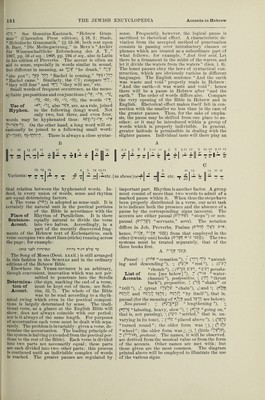
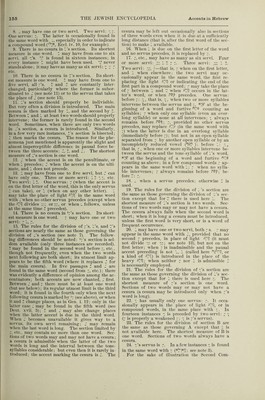
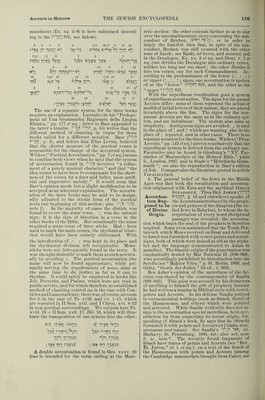
![JP?.” See Gesenius-Kautzscli, “Hebrew Gram- mar” (Clarendon Press edition), §16,3; Stade, “Hebraische Grammatik,” §§ 53-56; both rest upon S. Baer, “Die Methegsetzuiig,” in Merx’s “Archiv fur Wissenschaftliche Erforschung des A. T.,” 1867, pp. 56 et seq.; 1868, pp. 194 et seq., also in Latin in his edition of Proverbs. The accent is often an aid to sense, especially in words similar in sound, but different in meaning, as “he drank,” “she put”; ‘^,01 “Rachel is coming,” “Rachel came.” Similarly, the •>.??; compare, “they will fear” and “they will see,” etc. Small words of frequent occurrence, as the mono- syllabic prepositions and conjunctions -‘S., ''il, -8y, -'3^ the words '1'^., Use of also 'ft!, are, as a rule, joined Hyphen, to the following (long) word. Not only two, but three, and even four, words may be hyphenated thus; -ns On the other hand, a long word will oc- casionally be joined to a following small word: pl-7i?r'r^. There is always a close syntac- B sense. Frequently, however, the logical pause is sacrificed to rhetorical effect. A characteristic de- viation from the accepted method of punctuation consists in passing over introductory clauses or phrases which are treated as a subordinate part of what follows; for example, “And God said, Let there be a tirmament in the midst of the waters, and let it divide the waters from the waters” (Gen. i. 6). The lesser pauses obey the laws of syntactical con- struction, Avhich are obviously various in different languages. The English sentence “And the earth was waste and void” properly reads in Hebrew: “ And the earth—it was waste and void ”; hence there will be a pause in Hebrew after “and the earth.” The order of words differs also. Compare the very opening of the Bible in Hebrew and in English. Rhetorical effect makes itself felt in con- nection with the smaller no less than in the ca.se of the greater pauses. Thus, for the sake of empha- sis, the pause may be shifted from one place to an- other; or it may be introduced within a group of words which is properly indivisible. In general, greater latitude is permissible in dealing with the slighter pauses. Individual taste will there play an A 16 , 15 .18 17 T 35 15 „/ 15 .1.2 388 7.II 12 3 6 5.11 12 5 10 10 9.11 12 . j I 1 J II e 1 ^ Variants; ■ .19 19, 19 4 3 14 1311 ” “ “ —11—etc. (as above)or^ etc. C 20 19 19 21 21 tical relation between the hyphenated words. In- deed, in every union of words, sense and rhythm are equal determining factors. 4. The verse (1'’''°?) is adopted as sense-unit. It is certainly the natural unit in the poetical portions of the Bible in accordance with the Place of Rhythm of Parallelism. It is there Sentence- equally natural to divide the verse Accent, into two halves. Accordingly, in a part of the recently discovered frag- ments of the Hebrew text of Ecclesiasticus, each verse occupies two short lines (stichs) running across the page; for example: ;psi3 'jsS nn.'^Dii ni’nj I'jn oSij; The Song of Moses (Deut. xxxii.) is still arranged in this fashion in the Scrolls and in the ordinary editions of the Hebrew Bible. Elsewhere the Verse-division is an arbitrary, though convenient, innovation which was not per- mitted to penetrate into the Scrolls Determina- (the sign, marking the end of a verse, tion of must be kept out of them; see Sofe- Accent. rim, iii. 7). The whole of the Bible was to be read according to a rhyth- mical swing which even in the poetical composi- tions is largely determined by sense. The tradi- tional verse, as a glance at the English Bible will show, does not always coincide with our period; nor is it always of the same length. For purposes of accentuation each verse must be dealt with sepa- rately. The problem is invaiiably: given a verse, de- termine the accentuation. The leading principle of the system is halving (extended from the poetical por- tions to the rest of the Bible). Each verse is divided into two parts not necessarily equal; these parts are each divided into two other parts; this process is continued until an indivisible complex of words is reached. The greater pauses are regulated by important part. Rhythm is another factor. A group must consist of more than two words to admit of a marked pause within it. When thus the stops have been properly distributed in a verse, our next task is to indicate both the presence and the absence of a pause by the corresponding signs (accents). The accents are either pausal (°'i?'D?’? “stops”) or non- pausal “servants,” servi). The notation differs in Job, Proverbs, Psalms (O'Slb ^8; hence, ’PS!?-) from that employed in the other (twenty-one) books (°'7?P 'Pki?.). The two systems must be treated separately, that of the three books first. A. ^P-8 'P2,t?. Pausal: - (P’^P “ cessation ”), 7 C'P'l hI'V “ ascend- ing and descending ”), 7 “ rest ”), 1 (K'P 7 “rhomb”), J (’^'JP L'PP, “'i'?] geresha- List of turn [see below] ”), r ('’^^ “ water- Accents. channel ”), postpositive, \ ('PI “ thrust pyrepositive, 1 C!.® “shake” or “trill”), ,1 (great “chain”), (land': (n't^ and nD-;^73ni?. “by itself ”), that is, pausal (for the meaning of and P?P,P see below). Non-pausal : ; (*<?■; [®^]15 “ lengthening ”), - (Nnna “laboring, heavy, slow”), 1 (''<t'J,8 “going on,” that is, not pausing), *, ('N’^ “settled,” that is, un- varying in its tone), _ ('■'^>! “ placed above ”), •; (P?P? “ turned round ”; the older form was 7), 7 “ wheel ”; the older form was 7, 7), L (little ^.^P?']''), ~ (nnijx)^ pretonic. The names, it will be observed, are derived from the musical value or from the form of the accents. Other names are met with; but those given are the most common. The diagram printed above will be employed to illustrate the use of the various signs.](https://iiif.wellcomecollection.org/image/b29000488_0001_0201.jp2/full/800%2C/0/default.jpg)