Volume 1
The Jewish encyclopedia : a descriptive record of the history, religion, literature, and customs of the Jewish people from the earliest times to the present day / prepared ... under the direction of ... Cyrus Adler [and others] Isidore Singer ... managing editor.
- Date:
- 1901-1906
Licence: In copyright
Credit: The Jewish encyclopedia : a descriptive record of the history, religion, literature, and customs of the Jewish people from the earliest times to the present day / prepared ... under the direction of ... Cyrus Adler [and others] Isidore Singer ... managing editor. Source: Wellcome Collection.
200/752 (page 152)
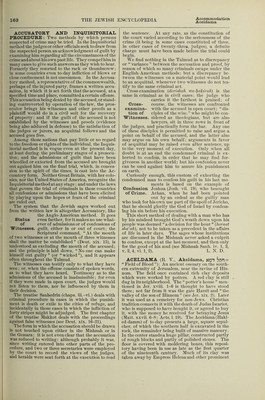
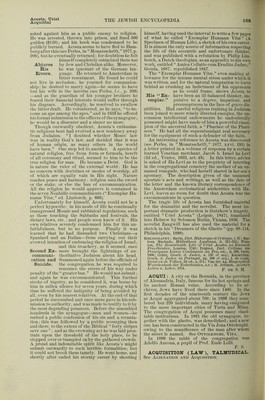
![Explanatory Notes. 1. The proper measure of a poetical verse is two short lilies (a distich or couplet). Such is the form of an ordinary verse in Proverbs. The main cesura is then marked by . But frequently, as in Psalms, a verse will contain three short lines (a tristich or triplet; that is, rhythm is sacrificed to sense); or a verse may contain four short lines (a tetrastich or quatrain; that is, two rhythmical verses making one sense-verse); or a verse, not necessarily long, may be trisected purely for reasons of sense or for the sake of oratorical emphasis. The main cesura will then be marked by - (a stronger -), while \ will be reserved for the secondary cesura (that is, the one between - and ■;). In the diagram the three by no means coordinate sections of the verse are des- ignated by the letters A, B, and C. In a short verse, therefore, drop A, and retain B and C. In a still sliorter verse (one consisting of but one short line), drop A and B, and retain C. This principle applies equally to the smaller sections on the diagram {that is, those limited by a pausal accent), the begin- ning of which may be lopped off to suit varying lengths. There will be found 7 in the sixth word from ■; and farther; it will be replaced by r occasionally in the fifth, and almost always in the fourth word; 7 is never used farther to the left • 7 is replaced by always in the first, occasionally also in the second, word (see note 19). 2. pp ''V. (for pn-^N)^ 3. The main cesura in section A is marked by 1; when a second cesura becomes necessary, 1 is re- peated. Observe, in general, that whenever an accent is repeated, the one farther to the left is the weaker. Between 7 and 7 there must be no word (in which case L is called little _) or at least two words (then we have great -). Two 7 s must equally be sepa- rated by at least two words. Wlien 1 becomes im- possible, - takes its place. Tlie sliortest measure of section A is two words; a cesura is always required. 4. The servus of 7 is - (or 7, when properly the hyphen should be employed; or ';, that is, with a PP?). This ; may occur in the same word with 7 (in ])lace of the light •’P.'?). Here PP’, “cutting off,” “separating,” is a line similar to tlie one used with and It occurs {a) before or after the divine name “to prevent its being joined, in the reading, to a word whieli—in the opinion of the accentuators—it was not seemly to bring into contact with it”; {b) be- tween two words of which tlie first ends in the same letter with which the seeond begins; (c) else- where, to mark an emphatic intonation. In all these cases, PP? introduces a slight pause after a non- pausal accent. 5. In the seetion limited by great 1 (great I’s sec- tion), the main cesura is marked by 1 (rarely by ':) and the secondary cesura by '7. When only one cesura is required, it is marked by (that is, the 1 section is cut off); but 1 is found in exceptional cases, and necessarily, when two servi are intro- dueed (see note 12). Sections of two words may and may not have a eesura. If required, it will, of course, be marked by . The shortest measure is one word. 6. Great 1 never has more than one servus, which is 7 (exceptionally 7 ; particularly when another 1 pre- cedes). When a pausal accent (1 or '7) precedes, it is 1, but 7 when an open syllable direetly (that is, no PPp intervening) preeedes the tone-syllable; these accents may appear in the same word with great j (7 taking the place of light -'?'?). 7. Seetions of two words will oceasionally have a cesura; it is omitted in the case of small words standing at the beginning of the section and ac- cented on the first syllable, unless emphasis is de- sired. The cesura in little I’s section is marked by '7. The shortest measure of little Ts section is one word. 8. Little 1 may have two servi, 7 7 (or 7 '.-); or one servus, 7. The two servi (7 7) appear occasion- ally in the same word (when the syllable immedi- ately preceding the tone is open); but this rule is not always obe3'ed. 9. The cesura in I’s section is marked by the same accent, and is dependent upon the same conditions as the cesura in little 7’s section (see note 7). A secondary cesura is seldom required; the accent marking the main cesura will then be repeated. The shortest measure of I’s section is one word. 10. ' may have two servi, 7 7 {t.e., - when the tone falls on the second letter and farther; 7 when on the first); or one servus, - (it may appear in- stead of light ■’PP. in the same word with 1) (or '7). In a few instances three servi are found: ' 7. 11. il , when a servus precedes; or when the tone falls on the third syllable or farther; in all other cases, '7 (the latter always between _ and 7). 12. There is no cesura in |l’s section. Its shortest measure is one word. Except in two instances, p. has never more than one servus, 7, when the tone is on the first syllable (but in two instances in the place of the hyphen); or on the second when it is simple and the first syllable is a simple closed one without heavy ; 7 when the condition mentioned in note 6 is fulfilled; 7 in all other cases (but 7 in a few instances where the 'IPp or 079 preceding the tone-sjdlable is abnormal). Two servi: 7 7; 7 in the place of a hyphen. 13. The rules for the diviision of 7’s seetion are the same as those laid down for great 7 (see note 5). 14. 7 lias properly' only one servus, 7 , when the tone is on the first syllable; 7 when on any other sydlable (but '7; also 7 exceptionally in two places; in one of them two consecutive 7’s are found); al- ways 7 when under a dageshed letter, except in three places, where 7 is found again. Exception- ally two servi are found: 7 7 ; the first is properly in the place of a hyphen; once we find 7 7, where again the first is in the place of a hyphen. 15. The main cesura in section B is marked bj' 7; for a second cesura. 7 will be repeated; and so on. The 7 s may follow each other closely. Properly, between 7 and 7 at least two words should inter- vene. This must always be the case when 1 marks a subordinate cesura; otherwise an interval of one word is frequently sufficient. When 1 becomes impossible or undesirable, 7 takes its place. The interval between 7 and 7 must never exceed one word. 7 is frequently found in the second word from 7. It is found in the first only when 7’s word is long; that is, when the tone-syilable therein is preceded by at least two syllables, or by one syl- lable, provided it is the bearer of a secondary accent (see § 3); otherwise 7 gives way to a servus. The shortest measure of B is two words (exeept after 7,](https://iiif.wellcomecollection.org/image/b29000488_0001_0202.jp2/full/800%2C/0/default.jpg)