Volume 1
The Jewish encyclopedia : a descriptive record of the history, religion, literature, and customs of the Jewish people from the earliest times to the present day / prepared ... under the direction of ... Cyrus Adler [and others] Isidore Singer ... managing editor.
- Date:
- 1901-1906
Licence: In copyright
Credit: The Jewish encyclopedia : a descriptive record of the history, religion, literature, and customs of the Jewish people from the earliest times to the present day / prepared ... under the direction of ... Cyrus Adler [and others] Isidore Singer ... managing editor. Source: Wellcome Collection.
205/752 (page 157)
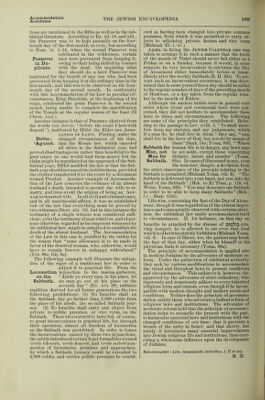
![I Abrahams, “Jewish Quarterly Review,” 1899, xi. 291 et seq. ' G. Tlie accentuation, like the vocalization, is cer- I tainly a post-Talmudic innovation. The treatise I Soferim, in which for the first time reference is made ; to points marking the beginning (or, ' Post-Tal- as it may be called, the end) of a verse ' mudic' (iii. 7), and possibly also to signs Origin. (points) by which the subdivisions of a verse are indicated, is post-Tal- mudic. PP? (Soferim, iii. 7) apparently means “ to cut up a verse”; compare Meg. 22«: pPp'p ''i' “I was not permitted to break up a verse”: in xiii. 1, reference is made to the stichic form of the texts of Psalms, Job, and Proverbs in which a verse (that is, a long verse) is said to be broken up into three parts by a blank left after the opening portion (nn'.T's, corresponding to y’s section), at the (this is apparently the correct reading; see the edition of Muller, Leipsic, 1878) and at tlie I end ('T'°). Observe that the terminology is far from ‘ fixed. In the Talmud itself reference is made to ' the practise of reciting the text in a manner accord- ing with the logical pauses (Meg. 3rt = Ned. 376; i Hag. 66 ; in Ber. 62 mention is made of a system of hand movements used by teachers in training their pupils to pause in the proper places), and ap- parently also to the habit of chanting (Meg. 32«), but not to written signs by which pauses are marked. The beginnings of our system of accentuation may therefore safely be placed in the sixth century. The first to prove the post-Talmudic date of the points and Accents was Elias Levita '^•7°?, 1538). See VocAi.izATioN. 7. One is led to the same conclusion by an exam- ination of the Syriac system of accentuation intro- duced at the end of the fifth century by the gram- marian Joseph Huzaya (Wright, “A Short History ! of Syriac Literature,” pp. 115 London, 1894), to j which the Hebrew system bears a striking resem- ' blance and from which it is apparently derived. The Syrians, apt disciples of the Greeks, adopted from the latter their method of reading, and accordingly I also their system of punctuation. Tlie Greeks dis- I tinguished three kinds of reading {avayvuai^); ora- ' torical or dramatic delivery implying declamation and gesticulation {nad' v-rroKpiatv); reading in accord- ance with the tone, that is, word-accent {Kara irpo- i audlav), and reading in accordance with pauses re- I quired by the sense (Kara SiaaToXijv). A single point (ariypr/), placed above or below or in the middle of the line, indicated the pauses; the upper point {relda 1 OTiy/itj) at the end of a period complete in itself j (avToreX^g), the lower point {vTzooTiyprj) between prot- ' asis and apodosis, and the middle point (iienn aTiyfiij) in a long sentence in order to iiermit the reader to take breath. Upon this modest system, which is found in our oldest Syriac manuscripts, Huzaya founded a more elaborate one to mark the subordinate divi- sions in a more regular and careful manner. The following diagram will illustrate the system (A means protasis, and B apodosis): B A Compare with this the Hebrew (prose) system in its essential parts; The point employed at the end the Syrians call pasoka, that is, “sector” ; P''f3 (corrupted into piD-) was apparently the name which in the Hebrew sys- tem belongs to the double point (;) marking the end of a verse. The Greeks also had a sign called vepiv (from which our “hyphen” is derived) to mark the coalescing of two syllables into one (synalephap The Syrians employed the same sign to join together two Syriac words used in translation of one Greek word; hence the Hebrew hyphen (see § 3). In the Hebrew system the rhetorical Accents (they were the signs of interrogation, exclamation, etc.)are wanting. How- ever, in distributing the pausesthe Jewish accentua- tors frequently pay attention to the requirements of rhetorical declamation (see the quotation from the “Manuel du Lectcur,” in ^lerx, j). 69, note 2; also Kalonymus ben David at the end of the Hebrew grammar of Abraham de Balnies, Venice, 1523). See Merx, “ Hi.storia Artis Grammaticic a])ud Sj’ros,” pp. 62e<«cy., Leipsic, 1889. On tlie origin (and function) of the minor pausal Accents see Buchler, “ Untersuch- ungen zur Entstehung und Entwickelung der He- briiischen Accente,” Vienna, 1891 (see also Griitz, “Monatsschrift,” 1882, jip. 38.5-409). 8. It is doubtful whether the vocalization and ac- centuation were introduced simultaneously. Per- haps the latter followed the former. Both became an object of care to the Masoretes, who, in addition to the task of preserving the traditional consonantal text intact, undertook to W'atch over the traditional vowel-points and accent-signs. Conqiare, for ex- ample, the Masoretic note to Jer. i. 7; that is, the words '*r8. 'P.Nl occur four times (i. 7, iii. 11, xi. 6, xv. 1; contrast iii. 6 and xi. 9) in Jeremiah thus accented. On tlie accentual variations of the Orientals (''8'7U'-) and Occidentals ('?‘?7>7p_) see jVIasokaii. Even more minute are the dill'erences between Ben Asiiek and Ben Napii- TALi. Our editions usually follow the former, Avho is the authority of the West. 9. The accentuation ofi'ers an invaluable aid to the understanding of the Biblical text. One must, how- ever, constantly bear in mind its limitations, which are of a twofold character. On the one hand, in at- tempting to accomplish too much, the sj'stcm fails in important points. In short verses its pauses are unnecessary; in long verses there are not enough of them. Sense is not infreiiuently sacrificed to rhetor- ical effect. The imperfection of the R3’steni is ]iar- ticularly noticeable in the awkwardness Avith which a parenthesis is indicated (compare, forexanijile, Jer. XX. 1). Nor is it always easy to tell just Avliat the accentuators had in mind in choosing a certain mode of accentuation. While, for the finer points of Bib- lical exegesis, a knoAvlcdge of the Accents is indisjien- sable, the beginner in the stud j' of the Bible should not be burdened Avith learning more than a fcAv of the important pausals, Avhich are quite sullicient for ordi- nary purposes. On the other hand, the accentuation represents the interpretation current in the JcAvish schools at a comparativelj^ late period. While, on the Avhole, the accentuation endeavors to be true to the natural meaning {peshat-, Avhich Value sec) of the Biblical documents, it does in Bible not altogether keep itself free from Interpreta- dogmatic prejudices (see I Sam. iii. tion. 3), Avhich it indeed shares Avith the ancient versions. At best the accen- tuation is representative of traditional JeAvish ex- egesis, Avhich the student of the Bible is frequently forced to overrule. The rule laid doAvn by Abra- ham iBN Ezra: nisn-s*? D'c;;on rns-Sj; vSn iS “ no interpretation of a Biblical pas- sage which does not folloAv the accentuation should be accepted,” Avas sinned against by every JeAvish commentator of importance, including Ibn Ezra](https://iiif.wellcomecollection.org/image/b29000488_0001_0207.jp2/full/800%2C/0/default.jpg)