Volume 1
The Jewish encyclopedia : a descriptive record of the history, religion, literature, and customs of the Jewish people from the earliest times to the present day / prepared ... under the direction of ... Cyrus Adler [and others] Isidore Singer ... managing editor.
- Date:
- 1901-1906
Licence: In copyright
Credit: The Jewish encyclopedia : a descriptive record of the history, religion, literature, and customs of the Jewish people from the earliest times to the present day / prepared ... under the direction of ... Cyrus Adler [and others] Isidore Singer ... managing editor. Source: Wellcome Collection.
721/752 (page 663)
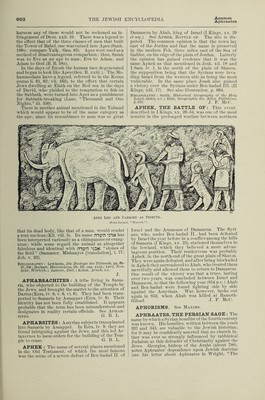
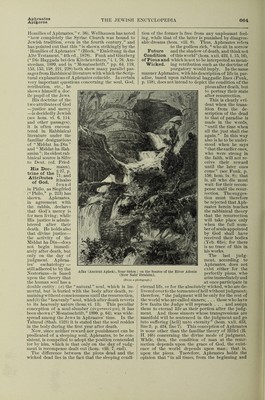
![Apamea Aphraates harness any of these would not be reckoned an in- fringement of Deut. xxii. 10. There was a legend to the effect that of the three classes of men that built the Tower of Babel, one was turned into Apes (Sanh. 109a: compare Yalk., Gen. 62). Ajies were used asa method of disadvantageous comparison; thus, Sarah was to Eve as an ape to man; Eve to Adam; and Adam to God (B, B. 58a). In the days of Enosh the human race degenerated and began to look like Apes (Gen. R. xxiii.). The DIo- hammedans have a legend, referred to in the Koran (suras ii. 61, 62; vii. 163), to the effect that certain Jews dwelling at Elath on the Red sea in the daj's of David, who yielded to the temi)tation to fish on the Sabbath, were turned into Apes as a punishment for Sabbath-breaking (Lane, “Thousand and One Nights,” iii. 550). There is another animal mentioned in the Talmud which would appear to be of the same category as the ape; since its resemblance to man was so great Damascus by Ahab, king of Israel (I Kings, xx. 29 et fseq.). See Apiikk, Battle ob\ The site is dis- puted. The common opinion is that the town lay east of the Jordan and that the name is preserved in the modern Eek, three miles east of the Sea of Galilee, on the edge of the plain of Jordan. Latterly the opinion has gained credence that it was the same Aphek as that mentioned in Josh. xii. 18 and I Sam. iv. 1, in the north of the plain of Sharon, the supposition being that the Syrians were inva- ding Israel from the western side as being the most vulnerable. In the same place Joash ahso gained a victory over the Syrians under Beu-hadad III. (II Kings, xiii. 17). See also illustration, p. 664. Bibliography : Smith, Historical Gcourapliu of the Holii ifUKi, index, s.v.; Buhl, Gcouraphie dcs Altcii Pnliistina, P.21:i. J. F. IdcC. APHEK, THE BATTLE OF: This event, described in I Kings, xx. 26-34, was one of the most notable in the iirolouged warfare between northern Apes Led and Carried as Tribute. (From Layard, “ Nineveh.”) that its dead body, like that of a man, would render a tent unclean (Kil. viii. 5). Its name bas been interpreted variously as a chimpanzee or orang- utan; while some regard the animal as altogether fabulous and identical with mtitn D3N. “stones of the field” (Sammter, Mislmayot [translation], i. 77; Job, V, 23). Bibliography : Lewisolin, Die Zoologie des Talmuds, pp. 84- 67,13.56: Bochart, Hierozoicon, lib. III. cap. xxxi.: Levy, Neu- hebr. Worterh.; Jastrow, Diet.; Kohut, Aruch, s.v. J. APHARSACHITES ; A tribe living in Sama- ria, who objected to the building of the Temple by the Jews, and brought the matter to the attention of Darius (Ezra, iv. 9, v. 6, vi. 6). They had been trans- ported to Samaria b}^ Asnapper (Ezra, iv. 9). Their identity has not been full3^ established. It appears probable that the term has been misunderstood and designates in reality certain officials. See Apiiar- siTES. G. B. L. APHARSITES : Assyrian subjects transplanted into Samaria by Asnapper. In Ezra, iv. 9. they are found intriguing against the Jews, and this led Ar- taxerxes to issue orders for the building of the Tem- ple to cease, G. B. L. APHEK : The name of several places mentioned in the Old Testament, of which the most famous was the scene of a severe defeat of Ben-hadad II. of Israel and the Arameans of Damascus. The Syri- ans. who, under Ben-hadad II., had been defeated by Israel the year before in a conflict among the hills of Samaria (I Kings, xx. 23), stationed themselves in the lowland, which they believed a more advan- tageous position. Their rendezvous was probably Aphek, in the north end of the great plain of Sharon. They were again defeated, and after being blockaded in Aphek they surrendered to Ahab, who treated them mercifully and allowed them to return to Damascus. One result of the victory was that a truce, lasting over two years, was concluded between Israel and Damascus, so that the following year (854 b.c,) Ahab and Ben-hadad were found fighting side by side against the Assj-rians, War, however, broke out aaain in 853, when Ahab was killed at Ramoth- Gilead. J- F. McC. APHORISMS. See Maxims. APHRAATES, THE PERSIAN SAGE : The name by which a Syrian homilist of the fourth century ■was known. His homilies, written between the years 337 and 345, are valuable to the Jewish historian; for it may be confidently asserted that no church fa- ther was* ever so strongly influenced^ by rabbinical Judaism as this defender of Christianity against the Jews. Georgios, bishop of the Arabs (about 780), notes Aphraates’ dependence upon Jewish doctrine (see his letter about Aphraates in Wright, “The](https://iiif.wellcomecollection.org/image/b29000488_0001_0727.jp2/full/800%2C/0/default.jpg)