Astronomy and particle physics : report, together with formal minutes, oral and written evidence.
- Great Britain. Parliament. House of Commons. Select Committee on Science and Technology
- Date:
- 2011
Licence: Open Government Licence
Credit: Astronomy and particle physics : report, together with formal minutes, oral and written evidence. Source: Wellcome Collection.
14/176 page 10
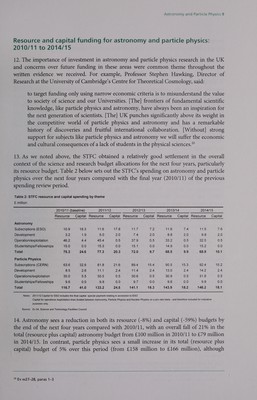
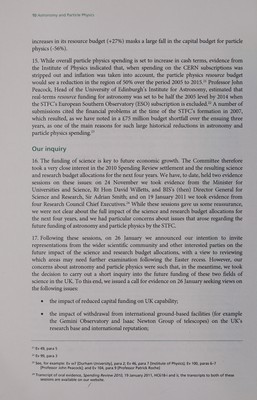
![increases in its resource budget (+27%) masks a large fall in the capital budget for particle physics (-56%). 15. While overall particle physics spending is set to increase in cash terms, evidence from the Institute of Physics indicated that, when spending on the CERN subscriptions was stripped out and inflation was taken into account, the particle physics resource budget would see a reduction in the region of 50% over the period 2005 to 2015.7 Professor John Peacock, Head of the University of Edinburgh’s Institute for Astronomy, estimated that real-terms resource funding for astronomy was set to be half the 2005 level by 2014 when the STFC’s European Southern Observatory (ESO) subscription is excluded.” A number of submissions cited the financial problems at the time of the STFC’s formation in 2007, which resulted, as we have noted in a £75 million budget shortfall over the ensuing three years, as one of the main reasons for such large historical reductions in astronomy and particle physics spending.” Our inquiry 16. The funding of science is key to future economic growth. The Committee therefore took a very close interest in the 2010 Spending Review settlement and the resulting science and research budget allocations for the next four years. We have, to date, held two evidence sessions on these issues: on 24 November we took evidence from the Minister for Universities and Science, Rt Hon David Willetts, and BIS’s (then) Director General for Science and Research, Sir Adrian Smith; and on 19 January 2011 we took evidence from four Research Council Chief Executives.“ While these sessions gave us some reassurance, we were not clear about the full impact of the science and research budget allocations for the next four years, and we had particular concerns about issues that arose regarding the future funding of astronomy and particle physics by the STFC. 17. Following these sessions, on 26 January we announced our intention to invite representations from the wider scientific community and other interested parties on the future impact of the science and research budget allocations, with a view to reviewing which areas may need further examination following the Easter recess. However, our concerns about astronomy and particle physics were such that, in the meantime, we took the decision to carry out a short inquiry into the future funding of these two fields of science in the UK. To this end, we issued a call for evidence on 26 January seeking views on the following issues: e the impact of reduced capital funding on UK capability; e the impact of withdrawal from international ground-based facilities (for example the Gemini Observatory and Isaac Newton Group of telescopes) on the UK’s research base and international reputation; 21 Ey 49, para 5 2 Ey 99, para 3 3 See, for example: Ev w7 [Durham University], para 2; Ev 46, para 7 [Institute of Physics]; Ev 100, paras 6-7 [Professor John Peacock]; and Ev 104, para 9 [Professor Patrick Roche] 4 Transcript of oral evidence, Soending Review 2010, 19 January 2011, HC618-i and ii; the transcripts to both of these sessions are available on our website. /](https://iiif.wellcomecollection.org/image/b3222204x_0014.jp2/full/800%2C/0/default.jpg)