Astronomy and particle physics : report, together with formal minutes, oral and written evidence.
- Great Britain. Parliament. House of Commons. Select Committee on Science and Technology
- Date:
- 2011
Licence: Open Government Licence
Credit: Astronomy and particle physics : report, together with formal minutes, oral and written evidence. Source: Wellcome Collection.
18/176 page 14
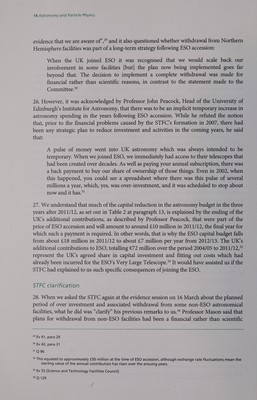
![evidence that we are aware of’,”’ and it also questioned whether withdrawal from Northern Hemisphere facilities was part of a long-term strategy following ESO accession: When the UK joined ESO it was recognised that we would scale back our involvement in some facilities [but] the plan now being implemented goes far beyond that. The decision to implement a complete withdrawal was made for financial rather than scientific reasons, in contrast to the statement made to the Committee.” 26. However, it was acknowledged by Professor John Peacock, Head of the University of Edinburgh’s Institute for Astronomy, that there was to be an implicit temporary increase in astronomy spending in the years following ESO accession. While he refuted the notion that, prior to the financial problems caused by the STFC’s formation in 2007, there had been any strategic plan to reduce investment and activities in the coming years, he said that: A pulse of money went into UK astronomy which was always intended to be temporary. When we joined ESO, we immediately had access to their telescopes that had been created over decades. As well as paying your annual subscription, there was a back payment to buy our share of ownership of those things. Even in 2002, when this happened, you could see a spreadsheet where there was this pulse of several millions a year, which, yes, was over-investment, and it was scheduled to stop about now and it has.” 27. We understand that much of the capital reduction in the astronomy budget in the three years after 2011/12, as set out in Table 2 at paragraph 13, is explained by the ending of the UK’s additional contributions, as described by Professor Peacock, that were part of the price of ESO accession and will amount to around £10 million in 2011/12, the final year for which such a payment is required. In other words, that is why the ESO capital budget falls from about £18 million in 2011/12 to about £7 million per year from 2012/13. The UK’s additional contributions to ESO, totalling €72 million over the period 2004/05 to 2011/12,” represent the UK’s agreed share in capital investment and fitting out costs which had already been incurred for the ESO’s Very Large Telescope.** It would have assisted us if the STFC had explained to us such specific consequences of joining the ESO. STFC clarification 28. When we asked the STFC again at the evidence session on 16 March about the planned period of over investment and associated withdrawal from some non-ESO astronomical facilities, what he did was “clarify” his previous remarks to us.*4 Professor Mason said that plans for withdrawal from non-ESO facilities had been a financial rather than scientific 22 Ev 41, para 29 3° Ev 42, para 31 31 Q 96 * This equated to approximately £50 million at the time of ESO accession, although exchange rate fluctuations mean the sterling value of the annual contribution has risen over the ensuing years. 3 Ev 55 [Science and Technology Facilities Council] 4'Q)\129](https://iiif.wellcomecollection.org/image/b3222204x_0018.jp2/full/800%2C/0/default.jpg)