Belfast and the province of Ulster in the 20th century / by Robert M. Young.
- Robert Magill Young
- Date:
- 1909
Licence: Public Domain Mark
Credit: Belfast and the province of Ulster in the 20th century / by Robert M. Young. Source: Wellcome Collection.
113/320 page 109
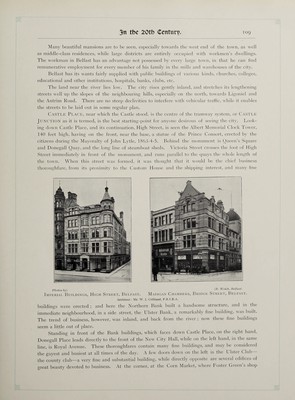
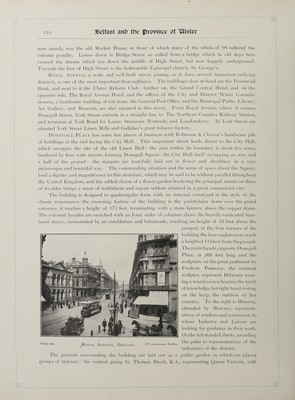
![Many beautiful mansions are to be seen, especially towards the west end of the town, as well as middle-class residences, while large districts are entirely occupied with workmen’s dwellings. The workman in Belfast has an advantage not possessed by every large town, in that he can find remunerative employment for every member of his family in the mills and warehouses of the city. Belfast has its wants fairly supplied with public buildings of various kinds, churches, colleges, educational and other institutions, hospitals, banks, clubs, etc. The land near the river lies low. The citv rises gently inland, and stretches its lengthening streets well up the slopes of the neighbouring hills, especially on the north, towards Ligoniel and the Antrim Road. There are no steep declivities to interfere with vehicular traffic, while it enables the streets to be laid out in some regular plan. Castle Place, near which the Castle stood, is the centre of the tramway system, or Castle Junction as it is termed, is the best starting-point for anyone desirous of seeing the city. Look¬ ing down Castle Place, and its continuation. High Street, is seen the Albert Memorial Clock Tower, 140 feet high, having on the front, near the base, a statue of the Prince Consort, erected by the citizens during the Mayoralty of John Lvtle, 1863-4-5. Behind the monument is Queen’s Square and Donegall Quay, and the long line of steamboat sheds. Victoria Street crosses the foot of High Street immediately in front of the monument, and runs parallel to the quays the whole length of the town. When this street was formed, it was thought that it would be the chief business thoroughfare, from its proximity to the Custom House and the shipping interest, and many fine Photos by] _ [R. Welch, Belfast. Imperial Buildings, High Street, Belfast. Madigan Chambers, Bridge Street, Belfast. Architect: Mr. W. J. Gilliland, F.R.I.B.A. buildings were erected ; and here the Northern Bank built a handsome structure, and in the immediate neighbourhood, in a side street, the L ister Bank, a remarkably fine building, was built. The trend of business, however, was inland, and back from the river ; now' these line buildings seem a little out of place. Standing in front of the Bank buildings, which faces dowm Castle Place, on the right hand, Donegall Place leads directly to the front of the New City Hall, while on the left hand, in the same line, is Royal Avenue. These thoroughfares contain many tine buildings, and may be considered the gayest and busiest at all times of the day. A few doors down on the left is the Ulster Club— the county club—a very fine and substantial building, while directly opposite are several edifices of great beauty devoted to business. At the corner, at the Corn Market, where boster Gieen s shop](https://iiif.wellcomecollection.org/image/b31366715_0117.jp2/full/800%2C/0/default.jpg)
 No text description is available for this image
 No text description is available for this image
 No text description is available for this image