Belfast and the province of Ulster in the 20th century / by Robert M. Young.
- Robert Magill Young
- Date:
- 1909
Licence: Public Domain Mark
Credit: Belfast and the province of Ulster in the 20th century / by Robert M. Young. Source: Wellcome Collection.
142/320 page 138
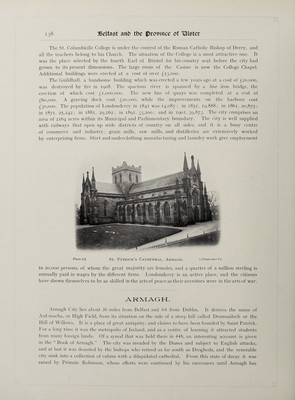
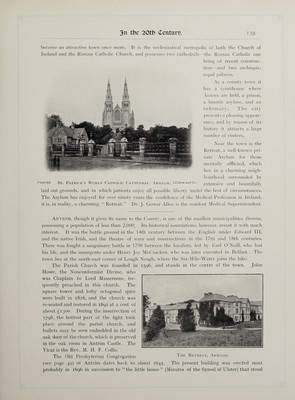
![The St. Columbkille College is under the control of the Roman Catholic Bishop of Derry, and all the teachers belong to his Church. The situation of the College is a most attractive one. It was the place selected by the fourth Earl of Bristol for his country seat before the city had grown to its present dimensions. The large room of the Casino is now the College Chapel. Additional buildings were erected at a cost of over £13,000. The Guildhall, a handsome building which was erected a few years ago at a cost of £20,000, was destroyed by fire in 1908. The spacious river is spanned by a fine iron bridge, the erection of which cost £1,000,000. The new line of quays was completed at a cost of £60,000. A graving dock cost £20,000, while the improvements on the harbour cost £30,000. The population of Londonderry in 1841 was 14,087 ; in 1851, 19,888; in 1861, 20,875 ; in 1871, 25,242; in 1881, 29,162; in 1891,33,200; and in 1901,39,873. The city comprises an area of 2164 acres within its Municipal and Parliamentary boundary. The city is well supplied with railways that open up wide districts of country on all sides, and it is a busy centre of commerce and industry; grain mills, saw mills, and distilleries are extensively worked by enterprising firms. Shirt and underclothing manufacturing and laundry work give employment Photo by] St. Patrick’s Cathedral, Armagh. {Allison an.i Co. to 20,000 persons, of whom the great majority are females, and a quarter of a million sterling is annually paid in wages by the different firms. Londonderry is an active place, and the citizens have shown themselves to be as skilled in the arts of peace as their ancestors were in the arts of war. ARMAGH. Armagh City lies about 36 miles from Belfast and 64 from Dublin. It derives the name of Ard-macha, or High Field, from its situation on the side of a steep hill called Drumsailech or the Hill of Willows. It is a place of great antiquity, and claims to have been founded by Saint Patrick, bor a long time it was the metropolis of Ireland, and as a centre of learning it attracted students from many foreign lands. Of a synod that was held there in 448, an interesting account is given in the “ Book of Armagh.” The city was invaded by the Danes and subject to English attacks, and at last it was deserted by the bishops who retired as far south as Drogheda, and the venerable city sank into a collection of cabins with a dilapidated cathedral. From this state of decay it was raised by Primate Robinson, whose efforts were continued by his successors until Armagh has](https://iiif.wellcomecollection.org/image/b31366715_0146.jp2/full/800%2C/0/default.jpg)
 No text description is available for this image
 No text description is available for this image
 No text description is available for this image