Belfast and the province of Ulster in the 20th century / by Robert M. Young.
- Robert Magill Young
- Date:
- 1909
Licence: Public Domain Mark
Credit: Belfast and the province of Ulster in the 20th century / by Robert M. Young. Source: Wellcome Collection.
93/320 page 89
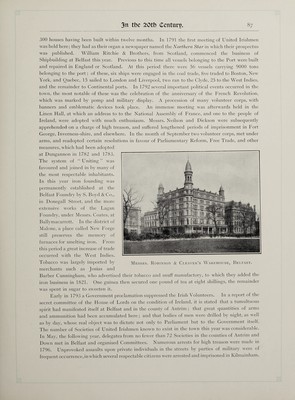
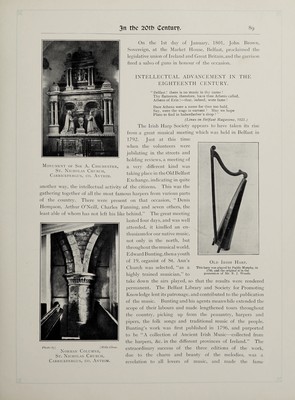
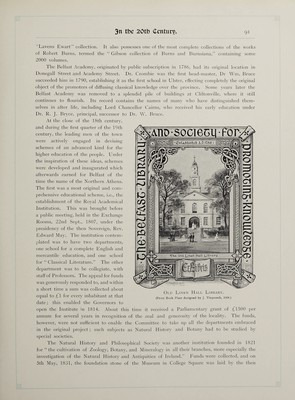
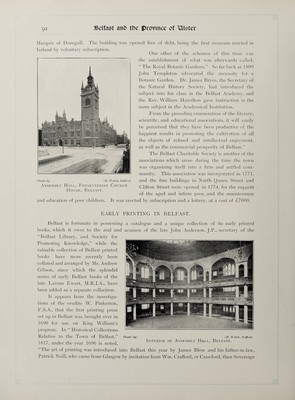
![On the 1st day of January, 1801, John Brown, Sovereign, at the Market House, Belfast, proclaimed the legislative union of Ireland and Great Britain,and the garrison fired a salvo of guns in honour of the occasion. INTELLECTUAL ADVANCEMENT IN THE EIGHTEENTH CENTURY. “ Belfast! there is no music in thy name ! Thy flatterers, therefore, have thee Athens called, Athens of Erin !—that, indeed, were fame ! Bare Athens were a name for thee too bald, Say, were the wags in earnest ? May we hope Plato to find in haberdasher’s shop? ” (Lines in Belfast Magazine, 1825.) The Irish Harp Society appears to have taken its rise from a great musical meeting which was held in Belfast in 1792. Just at this time when the volunteers were jubilating in the streets and holding reviews, a meetin Monument of Sir A. Chichester, St. Nicholas Church, Carrickfergus, co. Antrim. & of was a very different kind taking place in the Old Belfast Exchange, indicating in quite another way, the intellectual activity of the citizens. This was the gathering together of all the most famous harpers from various parts of the country. There were present on that occasion, “ Denis Hempson, Arthur O’Neill, Charles Fanning, and seven others, the least able of whom has not left his like behind.” The great meeting lasted four days, and was well attended, it kindled an en¬ thusiasm for our native music, not only in the north, but throughout the musical world. Edward Bunting, then a youth of 19, organist of St. Ann’s Church was selected, “as a Old Irish Harp. This harp was played by Paddy Murphy, in 1780, and the original is in the possession of Mr. R. J. Woods. Photo by] [Mills Close. Norman Columns, St. Nicholas Church, Carrickfergus, co. Antrim. highly trained musician,” to take down the airs played, so that the results were rendered permanent. The Belfast Library and Society for Promoting Knowledge lent its patronage, and contributed to the publication of the music. Bunting and his agents meanwhile extended the scope of their labours and made lengthened tours throughout the country, picking up from the peasantry, harpers and pipers, the folk songs and traditional music of the people. Bunting’s work was first published in 1796, and purported to be “A collection of Ancient Irish Music—collected from the harpers, &c. in the different provinces of Ireland.” The extraordinary success of the three editions of the work, due to the charm and beauty of the melodies, was a revelation to all lovers of music, and made the fame](https://iiif.wellcomecollection.org/image/b31366715_0097.jp2/full/800%2C/0/default.jpg)
 No text description is available for this image
 No text description is available for this image
 No text description is available for this image