Annual report of the General Board of Commissioners in Lunacy for Scotland : 42nd 1900
- Great Britain. General Board of Commissioners in Lunacy for Scotland.
- Date:
- 1900
Licence: Public Domain Mark
Credit: Annual report of the General Board of Commissioners in Lunacy for Scotland : 42nd 1900. Source: Wellcome Collection.
22/260
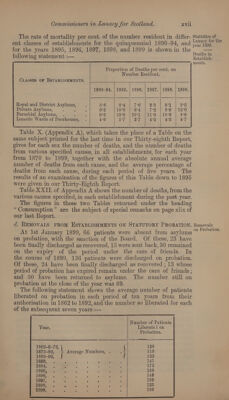
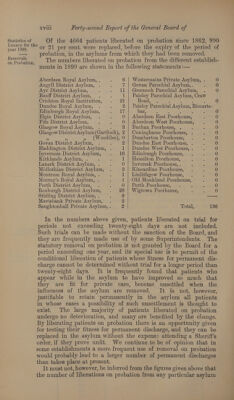
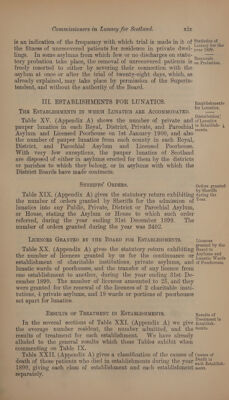
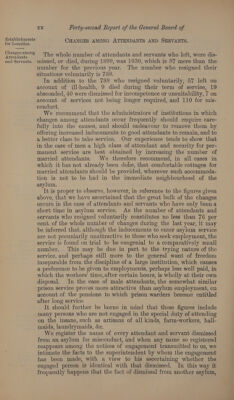
![acme tops CHANGES AMONG ATTENDANTS AND SERVANTS. or Lunatics. eee The whole number of attendants and servants who left, were dis- and Servants. missed, or died, during 1899, was 1030, which is 87 more than the number for the previous year. The number who resigned their situations voluntarily is 788. In addition to the 788 who resigned voluntarily, 57 left on account of ill-health, 9 died during their term of service, 19 absconded, 40 were dismissed for incompetence or unsuitability, 7 on account of services not being longer required, and 110 for mis- conduct. , . We recommend that the administrators of institutions in which changes among attendants occur frequently should enquire care- fully into the causes, and should endeavour to remove them by offering increased inducements to good attendants to remain, and to a better class to take service. Our experience tends to show that in the case of men a high class of attendant and security for per- manent service are best obtained by increasing the number of married attendants. We therefore recommend, in all cases in which it has not already been done, that comfortable cottages for married attendants should be provided, wherever such accommoda- tion is not to be had in the immediate neighbourhood of the asylum. It is proper to observe, however, in reference to the figures given above, that we have ascertained that the great bulk of the changes occurs in the case of attendants and servants who have only been a short time in asylum service. As the number of attendants and servants who resigned voluntarily constitutes no less than 76 per cent. of the whole number of changes during the last year, it may be inferred that, although the inducements to enter asylum service are not pecuniarily unattractive to those who seek employment, the service is found on trial to be congenial to a comparatively small number. This may be due in part to the trying nature of the service, and perhaps still more to the general want of freedom inseparable from the discipline of a large institution, which causes a preference to be given to employments, perhaps less wel] paid, in which the workers’ time, after certain hours, is wholly at their own disposal. In the case of male attendants, the somewhat similar prison service proves more attractive than asylum employment, cn account of the pensions to which prison warders become entitled after long service. It should further be borne in mind that these figures include many persons who are not engaged in the special duty of attending on the insane, such as artisans of all kinds, farm-workers, hall- maids, laundrymaids, &c. We register the name of every attendant and servant dismissed from an asylum for misconduct, and when any name so registered reappears among the notices of engagement transmitted to us, we intimate the facts to the superintendent by whom the engagement has been made, with a view to his ascertaining whether the engaged person is identical with that dismissed. In this way it frequently happens that the fact of dismissal from another asylum,](https://iiif.wellcomecollection.org/image/b31856573_0022.jp2/full/800%2C/0/default.jpg)