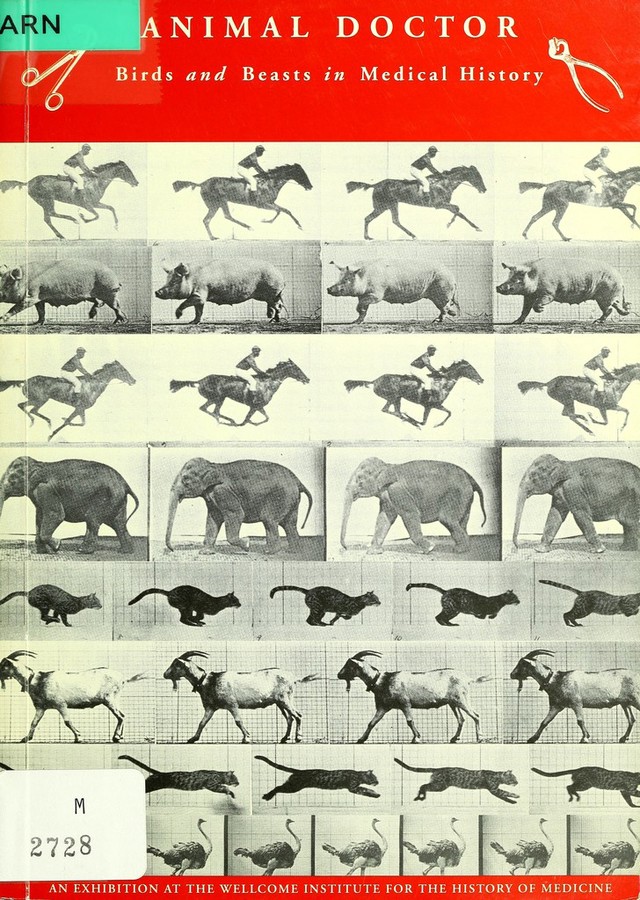
Animal doctor : birds and beasts in medical history an exhibition at the Wellcome Institute for the History of Medicine, November 1994 / Ken Arnold, Roy Porter, Lise Wilkinson.
- Wellcome Institute for the History of Medicine
- Date:
- 1994
Licence: Attribution 4.0 International (CC BY 4.0)
Credit: Animal doctor : birds and beasts in medical history an exhibition at the Wellcome Institute for the History of Medicine, November 1994 / Ken Arnold, Roy Porter, Lise Wilkinson. Source: Wellcome Collection.
8/68 page 6
![experimental subjects, including horses. And thereafter, vivisection proved the major technique for exploring the structure and functions of the nervous system, the nature of sensory motor responses and the pathways of pain. And even as medical scientists made their notable breakthroughs, protests grew against man's inhumanity towards animals. These took various forms. Humanitarians protested against casual violence in the name of fun - swinging cats and the other heartless pastimes exposed in the first of William Hogarth's Four Stages of Cruelty print-sequence. Cruel sports like bull- running, bear-baiting, and cock-fighting came under attack. Parliament became involved. Eleven bills were introduced between 1800 and 1835 against various forms of cruelty to animals. Most failed, but 1822 saw the passing of the Cruelty to Animals Act, which criminalized animal baiting. And two years later, the Society for the Prevention of Cruelty to Animals was founded. Some public outrage was targeted against the use of animals in medical science. Among the inferior professors of medical knowledge, [Samuel Johnson asserted,] is a race of wretches, whose lives are only varied by varieties of cruelty; whose favourite amusement is to nail dogs to tables and open them alive; to try how long life may be continued in various degrees of mutilation, or with the excision or laceration of the vital parts; to examine whether burning irons are felt more acutely by the bone or tendon; and whether the more lasting agonies are produced by poison forced into the mouth, or injected into the veins. Johnson was a great cat lover. Romanticism later created a new stereotype of the experimenter whose intellectual obsessions got the better of his heart: Dr Frankenstein. Having simmered in the first half of the nineteenth century, disquiet about vivisection boiled over in the 1870s, leading to the RSPCA prosecuting the French biologist, Eugane Magnan, for experiments conducted before a British Association meeting in Norwich in 1874, and to a popular agitation, linking many anti-doctor and anti-expert causes, for example, hostility to the Contagious Diseases Acts and to compulsory smallpox vaccination. The rise of animal experimentation, and the animal protection counter- movement targeted against vivisectors, sprang from a shared socio-cultural](https://iiif.wellcomecollection.org/image/b2045658x_0008.jp2/full/800%2C/0/default.jpg)