Licence: Public Domain Mark
Credit: Infant feeding by prescription / by Henry Ashby. Source: Wellcome Collection.
Provider: This material has been provided by The Royal College of Surgeons of England. The original may be consulted at The Royal College of Surgeons of England.
3/8
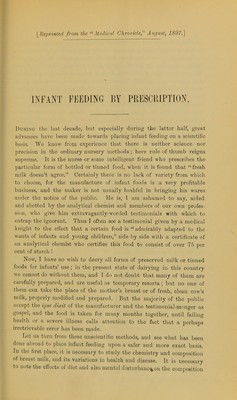
![[ Reprinted from the “Medical Chronicle,” August, 1897.] INFANT FEEDING BY PRESCRIPTION. During the last decade, but especially during the latter half, great advances have been made towards placing infant feeding on a scientific basis. We know from experience that there is neither science nor precision in the ordinary nursery methods ; here rule of thumb reigns supreme. It is the nurse or some intelligent friend who prescribes the particular form of bottled or tinned food, when it is found that “fresh milk doesn’t agree.” Certainly there is no lack of variety from which to choose, for the manufacture of infant foods is a very profitable business, and the maker is not usually bashful in bringing his wares under the notice of the public. He is, I am ashamed to say, aided and abetted by the analytical chemist and members of our own profes- sion, who give him extravagantly-worded testimonials with which to entrap the ignorant. Thus I often see a testimonial given by a medical knight to the effect that a certain food is “admirably adapted to the wants of infants and young children,” side by side with a certificate of an analytical chemist who certifies this food to consist of over 75 per cent of starch ! Now, I have no wish to decry all forms of preserved milk or tinned foods for infants’ use; in the present state of dairying in this country we cannot do without them, and I do not doubt that many of them are carefully prepared, aud are useful as temporary resorts; but no one of them can take the place of the mother’s breast or of fresh, clean cow’s milk, properly modified and prepared. But the majority of the public accept the ipse dixit of the manufacturer and the testimonial-monger as gospel, and the food is taken for many months together, until failing health or a severe illness calls attention to the fact that a perhaps irretrievable error has been made. Let ns turn from these unscientific methods, and see what has been done abroad to place infant feeding upon a safer and more exact basis. In the fiist place, it is necessary to study the chemistry and composition of breast milk, and its variations in health and disease. It is necessary to note the effects of diet and also mental disturbanc%ou the composition](https://iiif.wellcomecollection.org/image/b22382100_0005.jp2/full/800%2C/0/default.jpg)