Nostrums and quackery : articles on the nostrum evil and quackery reprinted from the Journal of the American Medical Association.
- Date:
- [1911]
Licence: In copyright
Credit: Nostrums and quackery : articles on the nostrum evil and quackery reprinted from the Journal of the American Medical Association. Source: Wellcome Collection.
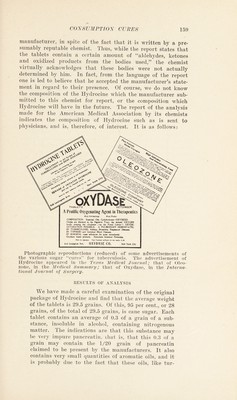
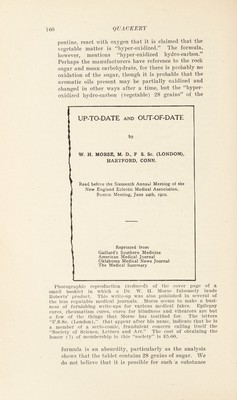
165/522 (page 161)
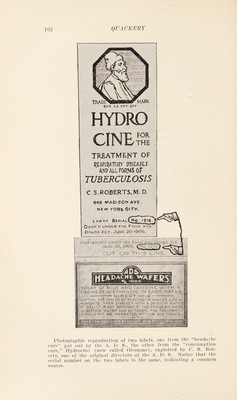
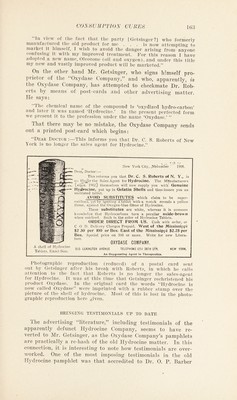
![CO^^SVMPTKm CURES IGl as turpentine, for instance, when in contact with suci ose (cane sugar) to act as an oxidizing agent. Apparently, therefore, the essential constituent of Hydro- cine, as it IS now offered to physicians, is cane sugar,^ and evidently this was the substance which was referred to as the “hyper-oxidized hydro-carbon.” As indicated by our chem- ist’s report, the very learned (?) statements regarding the hyper-oxidized hydro-carbon” or “oxidized carbo-hydrates” may be reduced to a simpler statement: “Each 29,5 grain Hydrocine tablet contains 28 grains of cane sugar and small cpiantities of volatile oils and a trace of pancreatin.” SUMMAEY To sum up, we have: A preparation, shown by analysis to be 95 per cent, cane sugar, put on the market to be retailed at a cost of $8 a pound (avoirdupois). The claim is made that by giving this preparation in 30-grain doses to the extent of one and a quarter ounces daily, tuberculosis can be “per- manently cured” in “from six to sixteen weeks.” To impress the unblinking, the main constituent in the formula is given a quasi-scientific name, meaningless in import. The exploiter of this “remedy” claims to have given up a practice yielding $10,000 annually “to spread the truth regarding this prepara- tion”—and incidentally, we suspect, to reap the benefits that must accrue from selling sugar at over $5 a pound, wholesale. Our chemist having translated for us into simpler language the statements as to the composition of the article, we, L physicians, should not find it difficult to interpret correctly the evidence on which the claims are based. {Modified from The Journal A. M. A., Feh, 15, 1008.) Oleozone—Oxydase—Cowles Institute Hydrocine is no more, but the commercial possibilities in sugar as a therapeutic agent are still recognized. Phoenix-like, there have arisen from the ashes of Hydrocine two other “hyper-oxidized hydro-carbons”—Oxydase and Oleozone. In fact, there seems to be at present no fewer than three con- cerns which are “curing” tuberculosis by means of sugar plus various incidentals. HYDROCINE OLEOZONE—OXYDASE Before Dr. Roberts “gave up a practice that was yielding . . . [him] an income of over $10,000.00 a year” to sell odoriferous sugar at $8.00 a pound, Hydrocine seems to have been manufactured by a Mr. E. C. Getsinger. It now seems that Getsinger and Roberts have parted company, for the country is being flooded with letters from Roberts in which he says:](https://iiif.wellcomecollection.org/image/b29002679_0165.jp2/full/800%2C/0/default.jpg)