Copy 1, Volume 1
Lectures on select subjects in mechanics, hydrostatics, hydraulics, pneumatics, optics, geography, astronomy, and dialling / By James Ferguson. With notes, and an additional volume, containing the most recent discoveries in the arts and sciences. By David Brewster.
- James Ferguson
- Date:
- 1823
Licence: Public Domain Mark
Credit: Lectures on select subjects in mechanics, hydrostatics, hydraulics, pneumatics, optics, geography, astronomy, and dialling / By James Ferguson. With notes, and an additional volume, containing the most recent discoveries in the arts and sciences. By David Brewster. Source: Wellcome Collection.
53/406 page 17
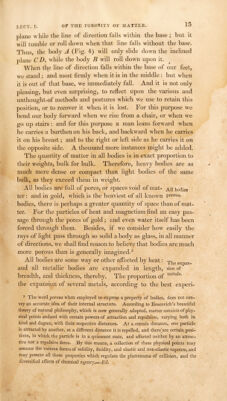
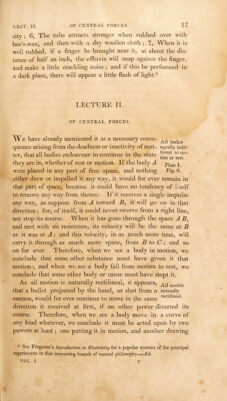
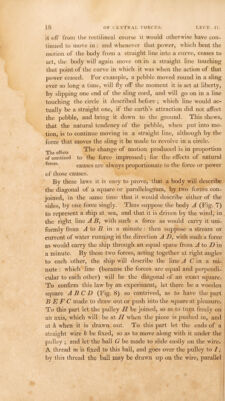
![city; G, The tube attracts stronger when rubbed over with beeVwax, and then with a dry woollen cloth ; 7, When it is well rubbed, if a finger be brought near it, at about the dis- tance of half an inch, the effluvia will snap against the finger, and make a little crackling noise ; and if this be performed in a dark place, there will appear a little flash of light.6 LECTURE II. OF CENTRAL FORCES. We have already mentioned it as a necessary conse- bodieg quence arising from the deadness or inactivity of mat- equally indtfo ter, that all bodies endeavour to continue in the state J5rent t0 ™° they are in, whether of rest or motion. If the body A plate j were placed in any part of free space, and nothing Fig. 6. either drew or impelled it any way, it would for ever remain in that part of space, because it could have no tendency of itself to remove any way from thence. If it receives a single impulse any way, as suppose from A toward i?, it will go on in that direction ; for, of itself, it could never swerve from a right line, nor stop its course. When it has gone through the space A B, and met with no resistance, its velocity will be the same at B as it was at A ; and this velocity, in as much more time, will carry it through as much more space, from B to C; and so on for ever. Therefore, when we see a body in motion, we conclude that some other substance must have given it that motion; and when we see a body fall from motion to rest, we conclude that some other body or cause must have stopt it. As all motion is naturally rectilineal, it appears, An motion that a bullet projected by the hand, or shot from a naturally cannon, would for ever continue to move in the same recti]ineal* direction it received at first, if no other power diverted its course. Therefore, when we see a body move in a curve of any kind whatever, we conclude it must be acted upon by two powers at least; one putting it in motion, and another drawing 6 See Ferguson’s Introduction to Electricity for a popular account of the principal experiments in that interesting branch of natural philosophy.—-Ed. VOL. I. C](https://iiif.wellcomecollection.org/image/b29329966_0001_0053.jp2/full/800%2C/0/default.jpg)
 No text description is available for this image
 No text description is available for this image
 No text description is available for this image