Anniversary address, delivered before the Anthropological Society of London, January 3rd, 1866 / by James Hunt.
- James Hunt
- Date:
- 1866
Licence: Public Domain Mark
Credit: Anniversary address, delivered before the Anthropological Society of London, January 3rd, 1866 / by James Hunt. Source: Wellcome Collection.
Provider: This material has been provided by The Royal College of Surgeons of England. The original may be consulted at The Royal College of Surgeons of England.
4/24 page 2
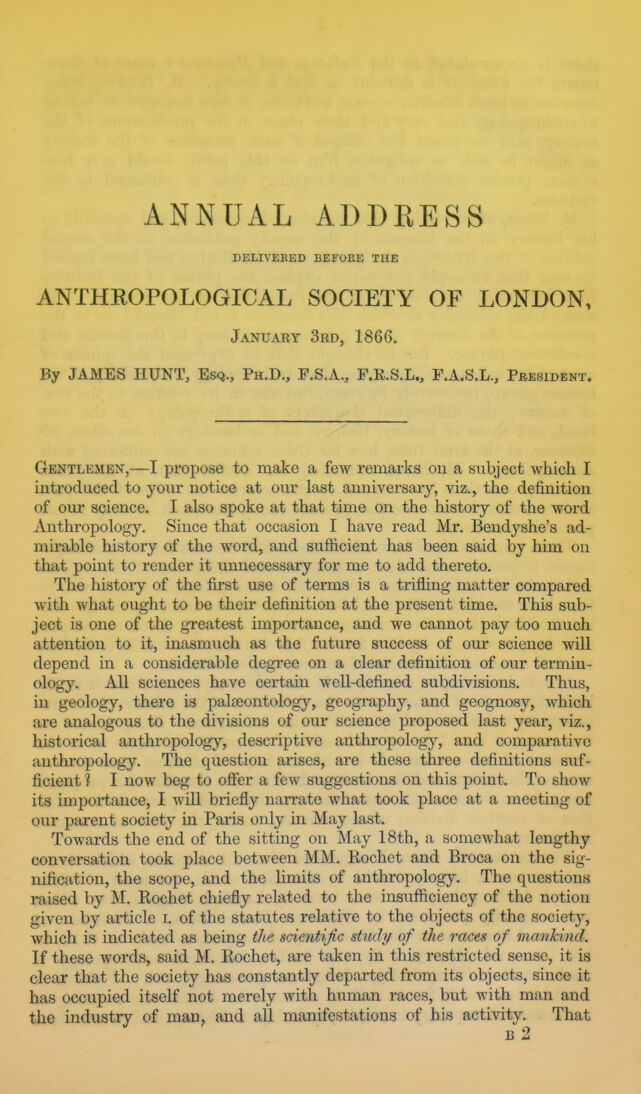
![there is acciinmlated in the Bulletins and Manoires a mass of docu- ments for -\vhicli it is difficult to find a centre. INI. Rochet, being desirous to learn whether certain works he is now engaged in belong to anthropology and may find their place in the publications of the society, said he would feel obliged if such members of the society as might be able to enlighten him on this point, would give him a more precise definition of anthropology than is contained in the statutes. M. Broca, after stating that on several occasions, and specially in his history on the labours of the society published in the second volume of the Memoires, the questions of M. Rochet had been replied to, said that ho could not better explain the phrase of the statutes than by giving the history of the foundation of the society. He showed the necessity in which the founders found themselves in the presence of the distmst of the government to keep to this laconic aird insufficient phrase. But he thought that he expressed the opinion of most of his colleagues, by saying that Anthropology is the study of the human gi'oup, not merely by itself, but also in its relation to the rest of nature; the differential characters of anthropology on the one hand, and those of history, biology, and archfeology on the other, in- dicating, at the same time, how far these schemes are connected with anthropology. M. Broca reminded M. Rochet that at all times artistic productions have served to characterise the races of the past as documents characterise the present races, inasmuch as they reveal particular aptitudes. These remarks show how advisable it has become for all anthropo- logists to possess some clear conception and definition of the objects and limits of their science. When an anthropological society was to have been founded in Paris in 1846, objection was taken by the govern- ment of that day to the formation of such a society. Even at the ]ire- sent day, we cannot say how far our fellow-students are able to declare the full meaning and extent of anthropological science. It Avill, however, be seen from M. Broca’s reply, that there is really little difference of opinion as to the definition of the science of anthro- pology by ourselves and by our Parisian colleagues. Being agreed on this point, it Avould be very advisable if we could also agree as to the divisions of our science. It is with the hope of eliciting some discus- sion on this point, and also becaxise I think the classification proposed last year to some extent unsatisfactory, that I now propose the addi- tion of another division of our science, under the title of Archaic Anthropology. Twelve months since, I suggested that all subjects Avhich throw light on man’s histoiy should be classified under the head of “ His- torical Anthropology”; a term used by Rudolph Wagner, but Avhich Avas originally proposed by Christian Daniel Beck, a Professor of Ancient Literature in the University of Leipsic, as early as 1813, in his Universal History. By this writer, historical anthropology is made to include mytliology, language, genealogy, etc. I think it Avonld be advisable for us still to continue to confine the meaning of historical anthropology to man’s psychological history, and to introduce](https://iiif.wellcomecollection.org/image/b22342151_0006.jp2/full/800%2C/0/default.jpg)