The principles and practice of obstetric medicine and surgery : in reference to the process of parturition / by Franics H. Ramsbotham.
- Francis Henry Ramsbotham
- Date:
- 1865
Licence: Public Domain Mark
Credit: The principles and practice of obstetric medicine and surgery : in reference to the process of parturition / by Franics H. Ramsbotham. Source: Wellcome Collection.
Provider: This material has been provided by the Harvey Cushing/John Hay Whitney Medical Library at Yale University, through the Medical Heritage Library. The original may be consulted at the Harvey Cushing/John Hay Whitney Medical Library at Yale University.
49/778 page 47
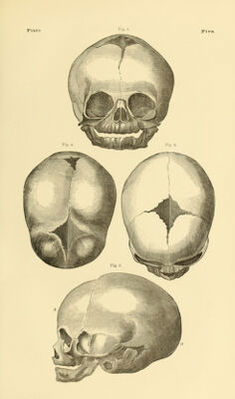
![• ■ 5, fig. 2, '/, /■): the short from the tuberosity of one parietal bone to that of the other (plate 5, fig. 4, a, b). In extent, at birth, the long diameter measures four inches and n half,'and the short three and i half; the circumference, drawn in a line over the the occipital bone, above the ears, and traversing the most promi- nent part of the frontal bones, is nearly fourteen inches. It must not be supposed that these measurements are exact or universal, any more than that the admeasurements given of the pelvis are always the same: but as we take ■ fancied Btandard pelvis as our guide, in the Bame manner we choose a Btandard head—such a one. perhaps, as is most commonly met with. I shall only mention one other diameter of the foetal head, because, by multiply- ing Mich observations unnecessarily, the miml is distracted and the memory l i/.. : that from the vertex to the chin, which is five inches and a half, capable, however, of elongation under labour, from tlie head being Compressed laterally, to the extent of six and a half or seven inches.1 The long diameter of the cranium, from the forehead to the occiput, being four inches and a half, ami the short diameter three and a half, it follows that, when the head is properly adapted to the pelvis, a clear superabundant space of at least half an inch is left between the cranial and pelvic bones, butl] iii the lateral and conjugate diameters, which is generally quite sufficient for the easy passage of the head. [In considering the fetal head, we obtain a more accurate knowledge of its form and dimensions by dividing it into a certain number of circumfe- meters would indicate the relative proportions of the fetal bead to those of the canal through which it has to pass. To designate these diameters by the points from which they are computed seems to com- bine the double advantage of affording the required measurements, and at time of informing us of the points of the fetal head in coincidence with certain parts of the pelvis. In this country we are in the habit of reckoning four distinct regions, OVals or circumferences ' Of the fetal head, rep by their respective diameters, viz.: occipitomental circumfe- rence, represented by occipito- mental diameter (a, 6), measur- bes; occipito-frontal (d, <i. 4-]'!; bi-parietaJ (o, b), ■ the ikutl of 11 • •- mala child at birth is a little larger in all its ui thai t t!i- female. Of rixty male, and titty female ehil-lreti, born m full tiiin-. Dt -l ia. i':n»i' found the average eiroomferei f 111•- head to be II inches in the irch, from ear to ear w-r the orown, was T| in the males, decimal nnurcs. tin* 'litference will -tiui'l thus: — mull' rliiUivn la'.'vi, nf ffiiiule 18-617; difference ■ 7 __'l. So tbat the average ead in the male measures almost exactly thr eighths of an inch more than the female; >nd from ear < tarter of an inon rej consequently its • .f mi inch 1 ->ii•^•-r. >■••• iii Foreign i.tii o li-i ]y M , i. 192, for the mi beads or 884 children, by Prof. ThruNtriip. of Christiana, which singular ui ih- 120 examined bj ;i- round, and all I S > m i - - m. in hi ••hiiioriitc Memoir. |.ui.li-lii-1 in the Klin. Med. and Surg. Journal i pore that both the parent and Infant than when a female; and he attributes this entirely '.D the largi r irn to possess over that ol the fen lie. It. lays, bis registry concurs with others in proving that nearly one-half wore mules are still-born than females; — tl](https://iiif.wellcomecollection.org/image/b21007123_0049.jp2/full/800%2C/0/default.jpg)