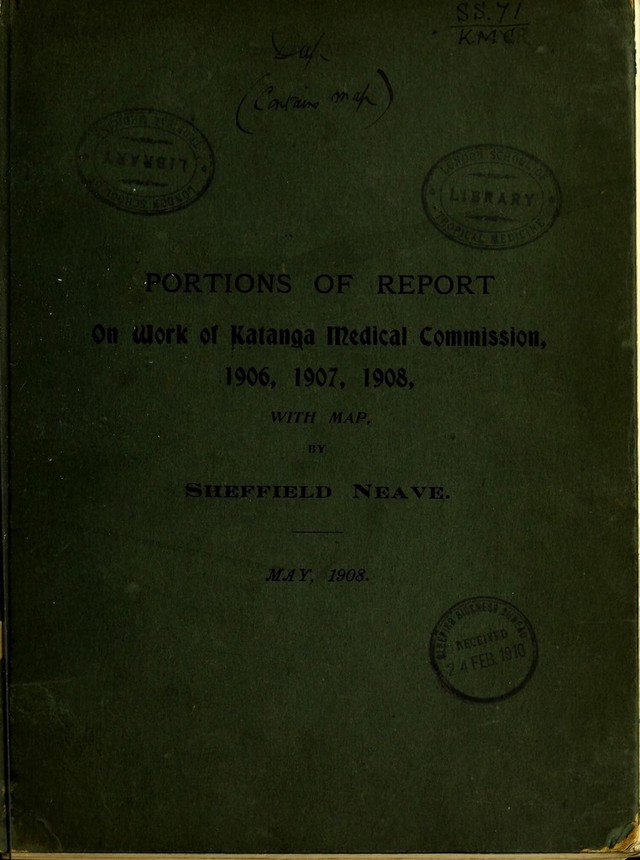
Portions of report on work of Katanga Medical Commission, 1906,1907,1908, with map / by Sheffield Neave.
- Neave, Sheffield Henry Morier, 1853-1936.
- Date:
- 1908
Licence: In copyright
Credit: Portions of report on work of Katanga Medical Commission, 1906,1907,1908, with map / by Sheffield Neave. Source: Wellcome Collection.
Provider: This material has been provided by London School of Hygiene & Tropical Medicine Library & Archives Service. The original may be consulted at London School of Hygiene & Tropical Medicine Library & Archives Service.
61/90 page 37
![(3) The Lufupa River. I visited this river at Chakamulwa's, near Lulua Post, and tlien some 20 miles lower down at Lukangala's. From this point I followed it nearly to its mouth. The Lufupa River runs in high plateau country until it reaches Ndzimina's Village, near the mouth of the Kamowa stream. I found no Palpalis on this part of the river. Some two or three miles, however, below this point the river descends through a gorge. Palpalis begins to make its appearance here, and occurs almost continuously down to its mouth. (4) The Lubudi River. I reached this river at Kambata's Village some ]0 miles above the junction with the Mkuleshi. Here Palpalis was abundant, and following up the river continued to make its appearance up to a point between Chianda's Village and the crossing on the Lulua-Kaiyoyo Road, near Sompo's Village. At this crossing the evidence was entirely negative, though there was no marked change in the character of the banks. The Lubudi in this part of its course is a shallow rapid river, with its banks almost uniformly well wooded. SOME NOTES ON THE HABITAT OF GLOSSINA PALPALIS AND ON THE SIGNIFICANCE OF THE ABOVE MENTIONED FACTS OF DISTRIBUTION. Upon the four rivers above mentioned I found the existence of Palpalis to almost invariably coincide with a certain type of country and with the characteristic Fauna and Flora arising therefrom. Palpalis seems to be always associated with well-wooded banks, and to avoid the grass- covered banks where the ]'ivers pass through alluvial plains. It seems to be specially associated with rapids, and was often seen basking on the rocks in such localities. In this region, which is comparatively near the watershed of the Congo Basin, these thickly wooded river banks are chiefly found in the more or less broken country through which the rivers descend from the High Plateau. As the rivers descend to lower elevations and (in this region) approach nearer the Equator, the forest areas tend to increase, though they are perhaps not so continuous as in the hilly regions. It appears to me also not impossible that on the lower ground, Palpalis will not be so absolutely confined to localities specially adapted to it, as is the case in this region of Katanga.](https://iiif.wellcomecollection.org/image/b2135683x_0061.jp2/full/800%2C/0/default.jpg)