Copy 1, Volume 1
The history of the popes, their church and state, and especially of their conflicts with Protestantism in the sixteenth and seventeenth centuries / Translated by E. Foster.
- Leopold von Ranke
- Date:
- 1847-1856
Licence: Public Domain Mark
Credit: The history of the popes, their church and state, and especially of their conflicts with Protestantism in the sixteenth and seventeenth centuries / Translated by E. Foster. Source: Wellcome Collection.
40/562 page 10
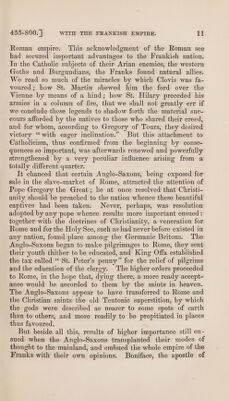
![made them masters of Spain; their general, Musa, boasting that he would march into Italy by the passes of the Pyrenees and across the Alps, and cause the name of Mahomet to be proclaimed from the Vatican. This position was all the more perilous for the western portion of Roman Christendom, from the fact that the iconoclastic dissensions were at that moment raging with the most deadly animosity on both sides. The emperor of Constantinople had adopted the opposite party to that fa- voured by the pope of Rome; nay, the life of the latter was more than once in danger from the emperor’s machinations. The Lombards did not fail to perceive the advantages de- rivable to themselves from these dissensions; their king, Astolphus, took possession of provinces that till then had always acknowledged the dominion of the emperor, and again advancing towards Rome, he summoned that city also to surrender, demanding payment of tribute with vehement threats.* The Roman see was at this moment in no condition to help itself, even against the Lombards; still less could it hope to contend with the Arabs, who were beginning to ex- tend their sovereignty over the Mediterranean, and were threatening all Christendom with a war of extermination. Happily, the true faith was no longer confined within the limits of the Roman empire. Christianity, in accordance with its original destiny, had long overpassed these limits—more especially had it taken deep root among the German tribes of the West; nay, a Christian power had already arisen among these tribes, and towards this the pope had but to stretch forth his hands, when he was sure to find the most effectual succour and earnest.allies against all his enemies. Among all the Germanic nations, the Franks alone had become Catholic from their first rise in the provinces of the * Anastasius Bibliothecarius: Vite Pontificum. Vita Stephani III. ed. Paris, p. 83.—‘‘ Fremens ut leo pestiferas minas Romanis dirigere non desinebat, asserens omnes uno gladio jugulari, nisi sue sese subderent ditioni,”’ [Furious as a lion, he desisted not from pouring forth deadly threats against the Romans, affirming that all should be destroyed by the sword unless they submitted themselves to his rule.]](https://iiif.wellcomecollection.org/image/b3309830x_0001_0040.jp2/full/800%2C/0/default.jpg)
 No text description is available for this image
 No text description is available for this image
 No text description is available for this image