Copy 1, Volume 1
The history of the popes, their church and state, and especially of their conflicts with Protestantism in the sixteenth and seventeenth centuries / Translated by E. Foster.
- Leopold von Ranke
- Date:
- 1847-1856
Licence: Public Domain Mark
Credit: The history of the popes, their church and state, and especially of their conflicts with Protestantism in the sixteenth and seventeenth centuries / Translated by E. Foster. Source: Wellcome Collection.
46/562 page 16
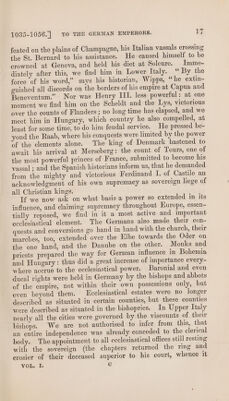
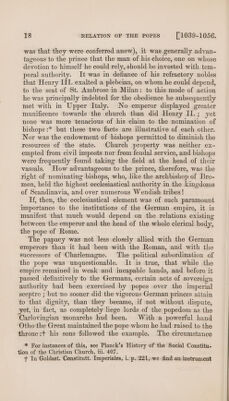
![_ But he received a degree of observance from the western churches (not excepting the Lombard, which had also been subjected to the Frankish laws and institutions) exceeding all that he had previously enjoyed. Permitting the introduction of schools for Frieslanders, Saxons, and Franks, into Rome, by which that city itself began to be Germanised, he thus in- duced that intimate connection of German and Latin elements which has since so actively influenced the general character of the West. In his utmost adversity the power of the pope struck new roots in a fresh soil; threatened by the most im- minent ruin, it was at thismoment that a firm and lengthened endurance was secured to it: the hierarchy, taking its rise in the Roman empire, now diffused itself over the German na- tions; these presented a boundless field for ever extending activity, and here it was that the germ of its being was first fully developed. § 3. Relation of the Popes to the German Emperors.— Internal progress of the Hierarchy. We now pass over some centuries, in order to arrive at that point of view whence the various events they produced may most profitably be considered. The empire of the Franks has fallen; that of the Germans has arisen into full and vigorous life. Never was the German name more powerful in Europe than during the tenth and eleventh centuries, under the Saxon and first Salique emperors. We see Conrad II. marching from the eastern frontier, where he had compelled the king of Poland to personal subjection, and to a division of his terri- tory, and condemned the duke of Bohemia to imprisonment, and pouring down on the West to support Burgundy against the pretensions of the French nobles. ‘These nobles he de- on the Mediterranean, Moesia, Dardania, and Preevalis]; also the loss of the patrimony in Calabria and Sicily. Pagi (Critica in Annales Baronii, jii. p. 216) compares this letter with one from Adrian I. to Charlemagne, whence it is obvious that these losses were among the results of the iconoclastic disputes.](https://iiif.wellcomecollection.org/image/b3309830x_0001_0046.jp2/full/800%2C/0/default.jpg)
 No text description is available for this image
 No text description is available for this image
 No text description is available for this image