Copy 1, Volume 1
The history of the popes, their church and state, and especially of their conflicts with Protestantism in the sixteenth and seventeenth centuries / Translated by E. Foster.
- Leopold von Ranke
- Date:
- 1847-1856
Licence: Public Domain Mark
Credit: The history of the popes, their church and state, and especially of their conflicts with Protestantism in the sixteenth and seventeenth centuries / Translated by E. Foster. Source: Wellcome Collection.
47/562 page 17
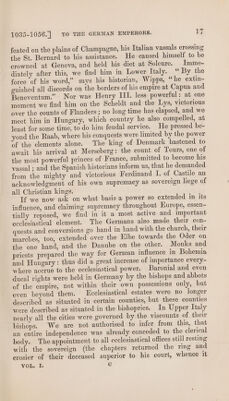
![ry 1035-1056.] TO THE GERMAN EMPERORS. iy feated on the plains of Champagne, his Italian vassals crossing the St. Bernard to his assistance. He caused himself to be crowned at Geneva, and held his diet at Soleure. Jmme- diately after this, we find him in Lower Italy. “ By the force of his word,” says his historian, Wipps, “ he extin- guished all discords on the borders of his empire at Capua and Beneventum.” Nor was Henry III. less powerful: at one moment we find him on the Scheldt and the Lys, victorious over the counts of Flanders ; no long time has elapsed, and we meet him in Hungary, which country he also compelled, at ieast for some time, to do him feudal service. He pressed be- yond the Raab, where his conquests were limited by the power of the elements alone. The king of Denmark hastened to await his arrival at Merseberg: the count of Tours, one of the most powerful princes of France, submitted to become his vassal ; and the Spanish historians inform us, that he demanded from the mighty and victorious Ferdinand J. of Castile an acknowledgment of his own supremacy as sovereign liege of all Christian kings. If we now ask on what basis a power so extended in its influence, and claiming supremacy throughout Europe, essen- tially reposed, we find in it a most active and important ecclesiastical element. The Germans also made their con- quests and conversions go hand in hand with the church, their marches, too, extended over the Elbe towards the Oder on the one hand, and the Danube on the other. Monks and priests prepared the way for German influence in Bohemia and Hungary: thus did a great increase of importance every- where acerue to the ecclesiastical power. Baronial and even ducal rights were held in Germany by the bishops and abbots of the empire, not within their own possessions only, but even beyond them. Ecclesiastical estates were no longer described as situated in certain counties, but these counties were described as situated in the bishoprics. In Upper Italy nearly all the cities were governed by the viscounts of their bishops. We are not authorised to infer from this, that an entire independence was already conceded to the clerical body. The appointment to all ecclesiastical offices still resting with the sovereign (the chapters returned the ring and crosier of their deceased superior to his court, whence it VOL. I. c](https://iiif.wellcomecollection.org/image/b3309830x_0001_0047.jp2/full/800%2C/0/default.jpg)
 No text description is available for this image
 No text description is available for this image
 No text description is available for this image