Licence: Public Domain Mark
Credit: Exsection of the hip-joint / by C.T. Poore. Source: Wellcome Collection.
Provider: This material has been provided by the Augustus C. Long Health Sciences Library at Columbia University and Columbia University Libraries/Information Services, through the Medical Heritage Library. The original may be consulted at the the Augustus C. Long Health Sciences Library at Columbia University and Columbia University.
27/36 page 21
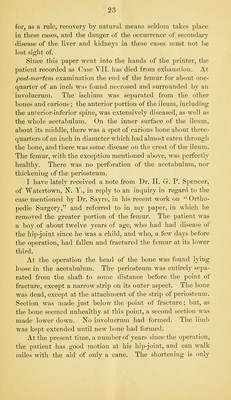
![•j.itropliic process, anl reiiiiiiiis, while preserving its external form, but a skeleton of itself. Mr. Holmes reports a case in St. George's Hospital Re- ports (vol. 1., page 147), where amputation was ])erformcd for extensive disease about the hip-joint, and where the femur was broken near its head in attempting to throw the head of the bone out in exsection. The femur was found soft and dis- eased at both ends. In the same paper Mr. Holmes says: It must often have struck surgeons, when excising a joint, that the operation has heen put off too long. The bone is soft, and its periosteum peels oif so readily that much care is necessary on the part of the assistant to avoid exposing it below the surface of the sec- tion. The compact wall appears thinned, and the cancellous tissue confused, crumbling, and filled with a somewhat puru- lent-looking marrow. He advocates amputation in these •cases. Mr. Annandale, in his paper on the Pathology and Treat- ment of ' Hip '-Disease, on page 13 makes the following re- marks : I have met with two cases of hip-disease in which the whole femur, ileum, and probably other of the bones, w^ere diseased through their whole structure; and on page 27 re- ports a case in which the bone was so soft that it had to be removed in pieces. In this way the neck, head, and great trochanter, were removed. The wound did not completely heal, so it was again enlarged, and two inches of the shaft of the femur removed. The shaft of the bone where divided w^as, however, diseased in the same way.'''' The patient died six months later. Dr. Sayre, in his work on Orthopedic Surgery, reports having seen a case in which Dr. Spencer, of Watertown, X. Y., had removed nearly the entire shaft of the femur, and perfect recovery took place. He does not state tlie condition •of the bone removed, or what he considers a perfect recovery. In looking over the table of exsections in the above- mentioned work I find that in lilteen cases the section was made Ijelow the trochanter minoi, on account of disease of the shaft; of these seven recovered and e'lght died. Of the seven who recovered the conditioii of the bone in two cases is re-](https://iiif.wellcomecollection.org/image/b21210640_0027.jp2/full/800%2C/0/default.jpg)



 No text description is available for this image
 No text description is available for this image
 No text description is available for this image