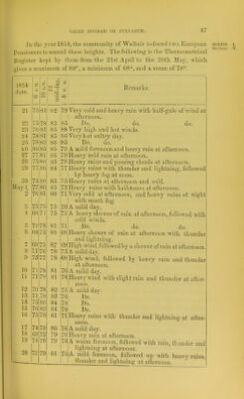
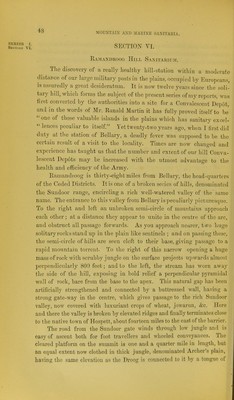
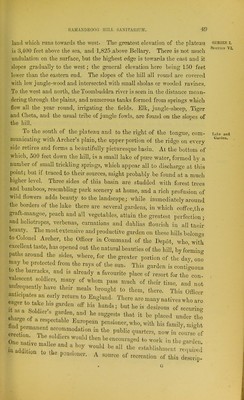
Reports on mountain and marine sanitaria : medical and statistical observations on civil stations and military cantonments., jails - dispensaries - regiments - barracks, &c. within the Presidency of Madras, the Straits of Malacca, the Andaman Islands, and British Burmah from January 1858 to January 1862 / by Duncan Macpherson.
- MacPherson, Duncan, M.D., 1812-1867.
- Date:
- 1862
Licence: Public Domain Mark
Credit: Reports on mountain and marine sanitaria : medical and statistical observations on civil stations and military cantonments., jails - dispensaries - regiments - barracks, &c. within the Presidency of Madras, the Straits of Malacca, the Andaman Islands, and British Burmah from January 1858 to January 1862 / by Duncan Macpherson. Source: Wellcome Collection.
88/458 (page 50)
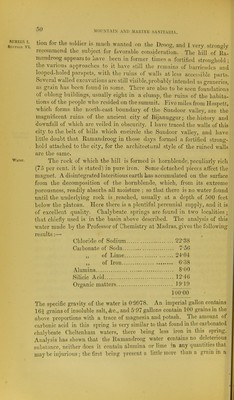
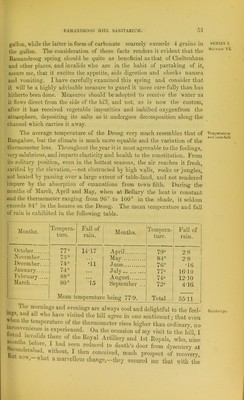
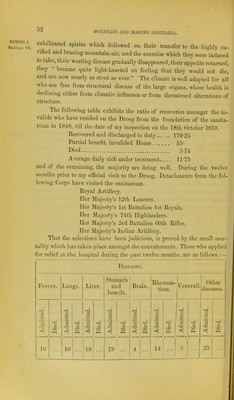
![MOl'N'l'AfN' AN'U llAIilNE SANITAIMA. SKRIES T. Section VI. Water. tion for tlie soldier is mucli wanted on the Droog, and 1 very strongly recommend the subject for favorable consideration. The hill of Ra- mandroog appears to have been in former times a fortified stronghold ; the various approaches to it liave still the remains of barricades and looped-holed parapets, with the ruins of walls at less accessible parts. Scveial \\ ailed excavations arc still visible, probably intended as graneries as grain has been found in some. There are also to be seen foundations of oblong buildings, usually eight in a clump, the ruins of the habita- tions of the jieople who resided on the summit. Five miles from llospett, which forms the north-cast boundary of the Siindoor valley, are the magnificent ruins of the ancient city of Bijanuggur; the history and downfall of which are veiled in obscurity. I have traced the walls of this city to the belt of hills which encircle the Sundoor valley, and have little doubt that Ilamandroog in those days formed a fortified strong- hold attached to the city, for the architeetural style of the ruined walls are the same. The rock of which the hill is formed is hornblende, peculiarly rich (7.5 ])er cent, it is stated) in pure iron. Some detached ])ieccs aficct the magnet. A disintegrated lateritious earth has accumulated on the surface from the decomposition of the hornblende, which, from its extreme porousness, readily absorbs all moisture ; so that there is no water found until the underlying rock is reached, usually at a depth of 500 feet below the plateau. Here there is a plentiful perennial supply, and it is of excellent quality. Chalybeate springs are found in two localities ; that chiefly used is in the basin above described. The analysis of this water made by the Professor of Chemistry at Madras, gives the following results:— Chloride of Sodium 22'38 Carbonate of Soda 7'56 ,, of Lime 2L04 ,, of Iron 638 Alumina S'OO Silicic Acid 12'40 Organic matters 19T0 100-00 The specific gravity of the water is 0'9978. An imperial gallon contains 163 grains of insoluble salt, &c., and 5‘97 gallons contain 100 grains in the above proportions with a trace of magnesia and potash. The amount of carbonic acid in this spring is very similar to that found in the carbonated chalybeate Cheltenham waters, there being less iron in this spring. Analysis has shown that the Kamandroog water contains no deleterious substance, neither does it contain alumina or lime :n any quantities that may be injurious ; the first being yircscnt a little more than a grain in a](https://iiif.wellcomecollection.org/image/b2809265x_0088.jp2/full/800%2C/0/default.jpg)